
[GHHF] Sant Eknath, a saint of Varkari Sampradaya; his amazing Guru Bhakti, and his Leelas (miracles)
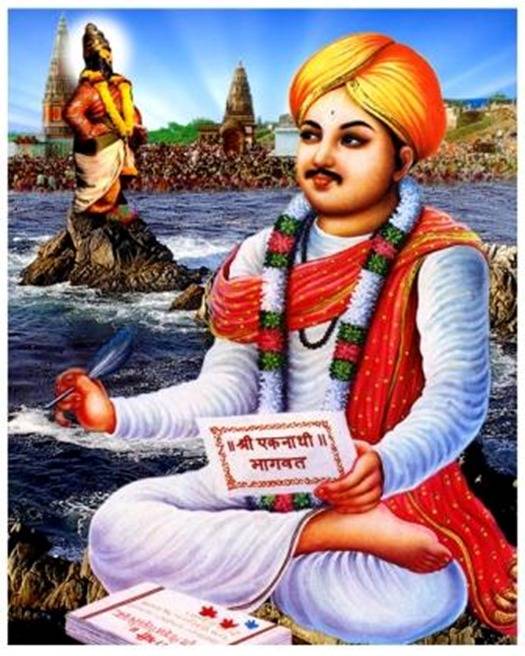 Sant Eknath (March 12, 1533–1599) was a prominent Marathi sant, scholar, and religious poet. In the development of Marathi literature, Eknath is seen as a bridge between his predecessors—Dnyaneshwar and Namdev—and the later Tukaram and Ramdas.
Sant Eknath was a major saint of the Varkari sampradaya, founded by Sant Gnyaneshwar. He was born in 1533 at Paithan. Eknath lost his parents at an early age and was brought up by his grandfather. Eknath's great-grandfather was Shri Bhanudas (1448-1513), a major figure in the Vitthala sect at Pandharpur. He wrote in Marathi to make spiritual knowledge accessible to common people, including abhangas (devotional songs) and bharuds (dramatic compositions).
Eknath was initiated by his guru, Janardana, a devotee of Dattatraya. Eknath was unique in that he blended Vedanta and Sufism. Eknath was a devotee of Guru Bhakta and wrote under the name of Eka-janardana, meaning eka of Janardana. Eknath wanted to get a good guru and prayed to Vitthal to guide him to one. Vitthobha then came in his dream and asked him to request Janardhana Swami to be his guru. Janardhana Swami was a great yogi; he had his ashram in a forest. Eknath felt that if he informed his parents, they would not let him go, and so one day he went to Janardhana Swami’s ashram without informing them. He joined the ashram and started serving his guru. He served Sadguru for 12 years. As per the instructions of his GURU, he married Girija Bai from Vijaypur, who was to prove to be one of the best assets of Eknath’s life. Her selfless devotion, perfect understanding, and her sharing his hardships with a happy heart marked her as a rare spouse, truly fit for a saint.
Guru wanted Lord Dattatreya to give darshan to his devotees. When Eknath was bringing water from the river back to the Ashram, Dattatreya gave him his darshan in godly form. The four Vedas stood next to him as 4 dogs. Dharma devata stood behind him as a bull. Eknath, on seeing him, prostrated to him. Dattatreya then blessed him. He was excited but never mentioned it to his Guru. Guru was confused and asked him why he did not even mention him. Eknath then replied to him that his Guru was everything to him and that he was happy to see this form of God rather than the form he saw in the morning. Hearing this, Janardhana Swami was moved. Janardhana Swami then asked him to go back to his parents, get married, and lead a family life. Eknath hesitated, not wanting to leave his guru, but Janardhana Swami told him he would realize his presence wherever he was. This consoled Eknath, and he returned home.
One day, Eknath was performing his ancestral rituals. Two outcastes happened to pass by his house and understood that a feast was being prepared. They were discussing that it would be good if they could get this food. Eknath, upon hearing these discussions, called them and gave them the food that was being prepared. They were happy with him, thanked him, and then left. The other Brahmans who had come for the ceremony left upon seeing this. All Brahmans in the village, on seeing this, started speaking ill of him for giving the food prepared for the ancestral ceremony to some outcastes before completing the ceremony. They all spoke among themselves and decided that Eknath should be punished for this deed. All the Brahmans in the village then came to Eknath and asked him how he could do this despite his learning of the sastras. Eknath then said that he had given them food as if they were hungry, that hunger doesn’t have any caste difference, and hence decided to feed them. He also said that the sastras state that annadanam can be given to anyone and that there is no caste discrimination in that. They then said that none of the Brahmans in the village would have any contact with him or his family from now on. Eknath now had to prepare food again for the ceremony and perform the ceremony. Eknath was now worried that he would not be able to feed the Brahmans after the ritual, as no one would come to his house. Kandiya Krishnan, his devotee, then told Eknath that if Brahmans were unavailable, the sastras say they could give it to kurcham (a type of holy dried grass used in religious ceremonies). Eknath then started performing the rituals, and when he kept the 1st kurcham, Vitthal came and sat down to eat. As soon as he came, other gods and his forefathers, who were called during the ceremony, came down and took the food directly.
The village Brahmins wanted Pariharam (Doing penance) to atone for his mistake and asked him for several items, such as a cow, land, a house, and so on. Eknath agreed to give Pariharam.
Then a Le Leper came to Eknath to pariharam. The village Brahmins were surprised that this leper came to do pariharam. They asked why he wanted to do Pariharam. The Leper said he came to do Pariharam because Ekanath is the only one who can do Prayaschittam for him. The leper said that the disease is not getting cured. He went to Triambakeswara and asked Lord Shiva. He then said that Lord Shiva came in his dream and asked him to take the pada Teertham (water taken by cleaning the feet of saints) of Eknath, and that it was the only cure for him. When Eknath heard that it was Lord Shiva's wish, he agreed. The leper then performed pada pooja for Eknath and consumed the water. As soon as he drank this water, his body became normal, and leprosy had vanished. The Brahmans there were astonished to see this. Krishnan then looked at the Brahmans and asked if they at least now understood the greatness of Eknath. The Brahmans no longer had the guts to continue with these pariharams they were doing.
One day, Eknath decided to go on a yatra, and he set out with a few others. They went to places such as Kasi, Prayag, Vrindavan, Ayodhya, and Mathura. Eknath performed Bhajans and pravachans wherever he went. When they finished the yatra and returned to Paithan with Ganga Teertham, they got stuck in a place with no water, and all of them were thirsty. Even though they had water in hand, they did not use it, as it was Ganga Teertham and was meant only for religious purposes, not for quenching thirst. They then found a donkey lying down in an unconscious state due to thirst and heat. Seeing the donkey dying, Eknath felt bad and moved forward to give it his Ganga Teertham to prevent its death. The others with him said he should not do that, as this water was meant only for religious purposes. Eknath then said that there was no better deed than saving the life of someone and that he would give it to the donkey and save it from death. Hearing this, the others left him behind and started moving forward, as they didn't approve of his action. Eknath then gave the donkey water. As Eknath was feeding the donkey, it turned out to be Vitthal. He then prostrated himself before Vitthal and asked him why he had done this to Leela. Vitthal then told him that he wanted to show the world that Eknath sees every living being in this world as Vitthal, and hence did this Leela. Eknath then returned home.
Three thieves crept into the inside rooms of EKNATH'S house and collected whatever pots and articles they could lay their hands on. They piled them near the door and went in for more. Then calamity struck. One after the other, the thieves became blind. Groping around for the way out, they stumbled upon the heap of pots, and the noise woke Eknath, who came to see what the trouble was about. Hearing his footsteps, the thieves who had realized that they had committed a crime by robbing the house of a saint, for which they had become afflicted with blindness.
Eknath called them and asked the reason for their fear, and all three fell at his feet and told him of their woe. He immediately passed his hands over their eyes, and they regained their sight. He called Girijabai and asked her and Uddhava to feed them, and then sent them away with all the pots they had stolen. The thieves, overwhelmed by his goodness and generosity, fell at his feet again and swore they would never steal again.
Seeing their change of heart, Eknath blessed them and explained: “God has come into my house in your forms, so go now, take these pots and start life anew, adhering to the honest path.”


 Urgent support needed for Bangladesh Hindus


