
[GHHF] Village Deities and the Living Tradition of Gramadevatas in India

https://bharatobserver.in/village-deities-and-the-living-tradition-of-gramadevatas-in-india/
(NOTE: This article was published in “The Bharat Observer by Sai Srinivas about Dhupa Deepa Naivedyam, one of the initiatives of the Global Hindu Heritage Foundation.)
A recent initiative by the Global Hindu Heritage Foundation distributed Dhupa Deepa Naivedyam kits to village temples so daily rituals to Gramadevatas could continue without interruption. The effort points to a much older and wider tradition: the worship of Gramadevatas, or village deities, which remains deeply woven into the spiritual and social life of many Indian villages.
What Gramadevatas Mean
Gram Devatas, or village deities, are guardian deities in Hindu tradition who are revered as protectors of the land, community health, agriculture, and social harmony. Rooted in ancient indigenous practices and later absorbed into Puranic and Agamic frameworks, they represent localized expressions of divine authority within specific settlements.
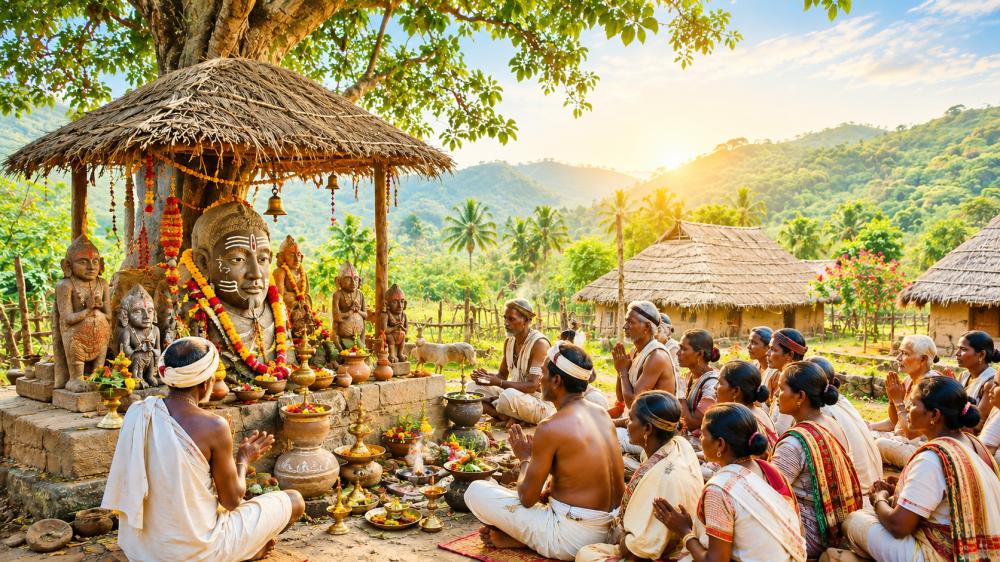
Across the villages of Bharat, sacred presence has always remained close to the soil, the well, the boundary stone, and the gathering square. Gram Devatas emerged from this close bond between people and place, where divinity was experienced not as a distant abstraction but as a living guardian of daily life. These deities were believed to watch over crops, protect cattle, restrain disorder, and uphold communal ethics through shared worship.
Sanatana Dharma never confined sacred authority to temples or texts alone. It allowed divine power to dwell wherever life unfolded according to dharma. Gram Devatas embody this vision by anchoring spirituality in locality and responsibility. Their worship shows how Hinduism balances universal metaphysical ideas with practical social needs without conflict.
Understanding Gram Devatas reveals Hinduism as a living civilizational system. It shows how Vedic ideas, Puranic theology, Agamic ritual, and folk practice came together to form a continuous religious fabric. This article presents their meaning, historical roots, philosophical basis, cultural role, and spiritual significance with fidelity to authentic Hindu sources.
Why Village Worship Matters
For villagers, Gramadevatas are living guardians of everyday life, not distant theological ideas. People seek their blessings before travel, during festivals, at the start of agricultural work, and in times of illness, drought, or hardship.
This worship also creates unity, as the deity becomes a shared protector for the whole village. It brings people together across family, caste, and social divisions, and is often seen as part of the community itself.
Village Temples in India
Village temples in India hold a deeply sacred place in the life of rural communities. They are often simple in structure, yet powerful in spiritual meaning, serving as living centers of devotion, tradition, and collective faith. Closely connected to seasonal festivals, agriculture, and oral memory, these temples preserve the rhythm of village dharma.
Many Gramadevatas are worshipped in sacred forms such as stones, holy trees, or spirit shrines, while others have small icons within modest temples. These forms reflect the enduring Hindu belief that divinity can reside in many sacred expressions and that worship remains most powerful when rooted in the lived experience of the people.
The Global Hindu Heritage Foundation Initiative
The Global Hindu Heritage Foundation (GHHF) has launched the Dhupa Deepa Naivedyam initiative to help financially challenged village temples continue their daily worship without interruption. The kits contain essential puja materials, including incense (dhupa), camphor, lamps (deepa), oil, cotton wicks, and other offerings, so that regular rituals to Gramadevatas can continue even in temples with limited resources.
According to GHHF, the initiative is intended not only to support temple priests but also to preserve village customs and strengthen the traditional role of Gramadevata temples as centers of community life. The foundation notes that many villagers continue to regard their Gramadevatas as protectors of the village, agriculture, health, and social harmony, making uninterrupted daily worship an important part of local religious practice.
The organization also describes the program as part of a broader effort to revive village based Hindu traditions. Beyond distributing puja materials, GHHF has undertaken renovation and reconstruction of neglected Gramadevata temples, provided support to economically struggling shrines, and worked to encourage regular participation in temple activities. In several rural and coastal regions, the foundation also operates Bala Samskara Kendras that teach children about Hindu values, traditions, and cultural practices.
GHHF has stated that many of its temple preservation initiatives focus on remote villages and economically weaker communities, where even basic ritual materials can be difficult to obtain. By ensuring that the daily offerings of Dhupa, Deepa, and Naivedya continue, the foundation aims to help village temples remain active centers of worship and preserve customs that have been passed down through generations.
Why This Matters Globally
For readers around the world, Gramadevata worship offers an important window into the local and community-centered side of Hinduism. It shows that Hindu traditions are not found only in grand temples and major pilgrimages, but also in small village shrines that preserve history, identity, and devotion through everyday practice.
For Indian readers, this is a reminder that village temples remain essential cultural institutions. Supporting them means preserving more than ritual; it means protecting a way of life that connects people to land, memory, and shared responsibility.
A Tradition Worth Preserving
Gramadevatas continue to represent protection, belonging, and continuity for rural communities. Whether worshipped at a boundary shrine, under a sacred tree, or in a small village temple, they remain central to the devotional life of many families.
The Global Hindu Heritage Foundation’s initiative helps ensure that these traditions do not fade due to neglect or financial strain. In doing so, it supports not only temple rituals, but the living cultural heritage of village India.
Your donations are appreciated:
By Zelle: ghhfusaorg@gmail.com
PayPal: savetemples.org
By Check: GHHF, 14726 Harmony Lane, Frisco, TX 75035.
By Rupees: call 601-918-7111; +91 83096 43979.



 Urgent support needed for Bangladesh Hindus


