
[GHHF] Why do Hindus worship Cows? What is its importance? What do scriptures say about the sacredness of cows?
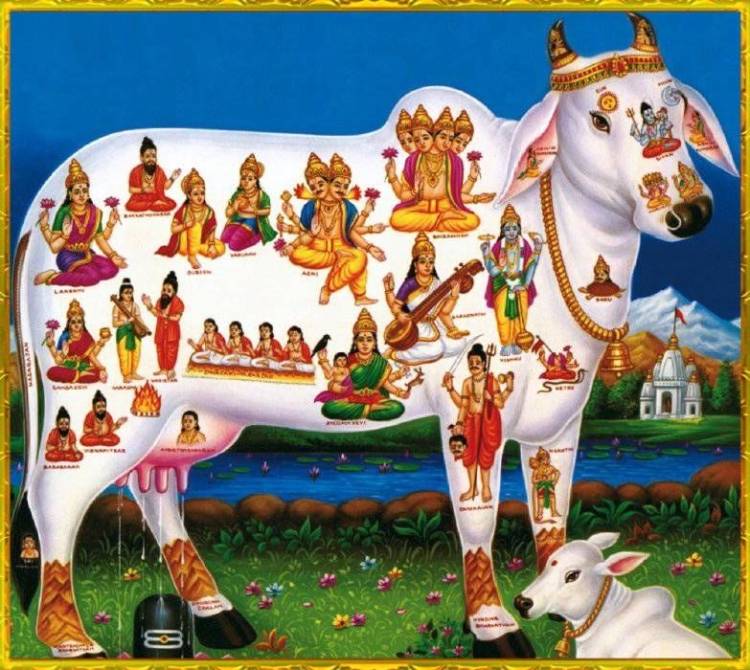 “May the Cows come to us, may they bring welfare, may they sit in our home, may they be satisfied with us. May they be plentiful in calves, in different forms, and in large numbers, may they be available for milking at Dawn for Indra.” Rig Veda 6:28:1
Hindus revere and honor cows as sacred beings because they symbolize motherhood, nourishment, non-violence, and the sustaining power of nature. In Hindu civilization, the cow represents a living embodiment of dharma, prosperity, and compassion. This reverence is rooted in Vedic scriptures, Puranas, Itihasas, and the traditional agrarian life of India.
Global Hindu Heritage Foundation performs Gau Puja every Monday before we perform Shiva Puja and Shiva Abhishekam in the villages. Cows are treated as equals to a mother. In fact, they are called Gau Mata. They worship the deities residing in Cows.
Since Vedic times, the cow has been considered sacred, treated as a mother, and hailed as a harbinger of auspiciousness. She is a symbol of wealth, health, prosperity, blessing, peace of mind, purity, purification, and success in life. She is identified as a Kamadhenu, a wish-fulfilling cow. She is revered, honored, and respected as a mother, an unselfish giver of bounty, expecting nothing in return from her children. All the scriptures, such as the Vedas, Upanishads, Puranas, the Mahabharata, the Manu Smriti, and others, extoll the virtues of the cow. All the Gods reside in her and killing her is considered the most heinous crime. It is often said “jivantu avadghnyah ta me vishasya dushanih” meaning that let cows live without slaughter for their whole life-they remove poison and toxins. Many sages, many Hindu Temples, and numerous Ashrams maintained Goshalas (cow shelters) for centuries, recognizing the numerous benefits that accrue from the cows.
It is unfortunate that India is becoming the third largest country to export beef to other countries ignoring the sacredness of the cows, is allowing the people to conduct beef celebration on the university campuses without permission, is tolerating the slaughter houses for political purposes, is failing to take appropriate actions against the minorities and other religious people who are deliberately hurting the sentiments of Hindus, and intentionally failing to take action in implementing constitutional requirements found in the Article 48 of the Constitution: “The State shall endeavor to organize agriculture and animal husbandry on modern and scientific lines and shall, in particular, take steps for preserving and improving the breeds, and prohibiting the slaughter of cows and calves and other milch and draught cattle.” Knowing the constitutional mandate and knowing the intentions of minorities and other religions to malign the Hindus, the Indian government and Hindu politicians are undermining the rich cultural heritage of Hindus that existed for centuries, and selling the country for their selfish and greedy purposes to accumulate wealth for the next few generations for their families.
Hindus have their future cut out for them – either be bulldozed and allow the government, minorities, and other religions to root out the very core of Sanatana Dharma from the soil of Bharath, or get united and exercise their freedom to restore the glory, grandeur, greatness, and grandness of the richest civilization that has ever surfaced on the planet earth. It is in the hands of Hindus to restore their culture, reestablish the concept of vasudaika kutumbam, insist on the welfare of all humanity, root out the sectarian appeasement, wipe out all kinds of terrorist activities, and aspire for the peaceful coexistence of humanity to live in freedom and independence. Hindus have to speak up for and protect their culture, values, and sentiments. It is in the best interest of the planet Earth that Hindus take the lead to protect the mother Cow and stand for the virtues of their religion.
All Gods Reside in Mother Cow
As the scriptures proclaim, “Tvam mata sarva devanam,” meaning that you are the mother of all gods. It also means that if we protect the cow, we honor all the gods who reside in her. Scriptures have elaborately described the location of the gods in the cow. We will examine our scriptures, such as the Vedas, Upanishads, Puranas, Mahabharata, and other scriptures, to equip ourselves with enough knowledge to find out the significance, importance, and virtues of cows so that we will not only reap the benefits of protecting them but also pass on the richness to our children and grandchildren.
All the scriptures agree that the four Vedas, with their six Vedangas (components), reside in the cow's mouth. Lord Shiva and Lord Vishnu live in her horns forever, Lord Brahma sits in her head, Karthikeya finds his home in her stomach, Sun and Moon live in her eyes, Garuda in her teeth, Ashwini Kumars in her ears, Goddess Saraswati in her tongue, Lord Indra in front of her horns, all pilgrimage centers in her posterior (back), Ganga in her urine, Yamaraj in her mouth, Gandharvas also reside inside her mouth, Goddess Lakshmi in the cow dung, Goddess Paravathi in the urine, Prajapati in the resonant voice, four Oceans in four teats (nipples) and milk, sky in the back portion and Varuna in the joints. In every pore of the body, all thirty-three crore Gods are positioned. In the stomach are the mountain ranges, with the forests, and the entire Earth.
Different kinds of Agni are positioned in different parts of the cow. Grahpratya-Agni, in her liver; Dakshina Agni, in her heart; Ahvaniya-Agni, in her neck; and Sabhya-Agni, in her palette. In the bones of the cows are to be found the mountains, while Rig Veda, Yajur Veda, Sama Veda, and Atharvana Veda are in their marrow. Hence, many Rishis worshipped the cows and also raised them in their ashrams.
Having possessed all the Gods in every part of her body, Cow blesses the people and country. Just looking at her enables one to have the fruits of offering salutations to all Gods, visiting all the pilgrimages, and acquire health and wealth. Happiness and peace thrive in a house where there is a cow. By circumambulating (Pradakshana) around the cow, one gets the punya (merit) of doing Pradakshana to all gods. Padma Purana states. “The person who touches the cow after having bathed daily, frees himself from all kinds of sins. The dust that arises from the cow’s hooves is so pure that the person who applies it on his head is considered to have bathed in the sacred waters of different pilgrim places and is freed from all sins.”
Since all Gods reside and manifest in the cow, she can bestow her blessings on all creatures. All substances that come from the cow are pure, chaste, and wholesome: they have the potential to purify the entire world. Cow’s urine, cow dung, milk, curd, and ghee – by the intake of these five products, the body is absolved of all sin. That is why religious people consume milk, ghee, and curd every day. Since all gods reside in her, whatever cows consume, her products are the best and purest. Of all the foods we consume, the effect of ghee lasts longest for one month, compared to grains, which last for only five days. The effect of milk lasts for seven days, and curds for twenty days. Since the pre-Vedic period, the cow is said to bestow Dharma, Artha, Kama, and Moksha - the four purusharthas. Hence, it is recommended to chant this mantra: ‘May cows forever remain in front of me, behind me, may all my limbs be blessed by the touch of the cow. May I reside amidst cows.’ This chanting will wash away all sins, and one is even worshipped in heaven for the merit of chanting.
Kamadhenu
Kamadhenu is a sacred cow known to fulfill all wishes and desires. This divine cow, which lives in Swarga Loka (heaven), emerged from the ocean of milk (ksheerasagar) during the time of Samudra Manthan (the churning of the ocean) by the gods (suras) and demons (asuras). It was presented to the seven sages by the Gods, and in the course of time came into the possession of Sage Vasishta.
Kamadhenu is also well known through its other five forms: Nandini, Sunanda, Surabhi, Susheela, and Sumana. According to the legends, Lord Brahma created the Brahmins (priests) and the cow at the same time; the Brahmins were to recite the religious scriptures while the cows were to provide ghee for offerings in religious sacrifices. Brahma also declared that Kamadhenu should be the mother of the gods; she ought to be worshipped by everybody. Anybody who killed a cow or allowed another to kill would rot in hell.
The cow symbolizes Dharma itself – fulfillment of righteous conduct. The cow represents Mother Earth. In Satya Yuga, dharma stood firmly on the four legs of the earth (cow); in Tretayuga, dharma stood on three legs; in Dwaparyuga, dharma stood on two legs; while in Kaliyuga, it stands on one leg. Hence, dharma is slowly slipping away from the people, and the age of deceit, decadence, deception, and dishonesty has set in. It is due to the negligence of reverence toward the cows and the prevention of abuse and killing them. Consequently, the whole world is facing untold misery, turmoil, terrorism, despair, debauchery, stress, and natural disasters. A happy cow represents prosperity, peace of mind, blessings, wealth, health, and purity. It is time to remember what Nandini cow said to King Dilip after he protected her from the Lion in a forest:
na kevalam payasa prasutim
ve hi man kam dugham prasannam
“Whenever I am pleased and happy, I can fulfill all my desires. Don't consider me to be just a milk supplier.”
Cows are welcome
In recognition of the virtues of a cow, a special place is accorded to her among Hindus. Cows are associated with prosperity and wealth. A newly purchased cow is welcomed into the home like a new bride. Whenever Pranaprathista to the deities is performed, cows are brought into the Temples and welcomed as the most revered guests. During certain festivals, the cow’s legs are washed, horns are decorated with different colors, the hump is smeared with colored powder, the body is beautifully decorated with colorful cloth, the forehead is anointed with tilak, and it is greeted with a kula or winnowing fan on which there is a dab of sindur or vermilion. A cow is welcomed into the house or temple with ingredients such as paddy, soft durva grass, sesame seeds, and a small brass pot containing a mango twig with leaves. It is like inviting all 33 crore gods into the house.
The Rishis (sages) discovered that the magnetism of a cow is due to the extraordinary virtues she possesses. No other animal equals her qualities. Even if you give the same kind of food to a cow and a horse, the horse dung emits an unhealthy, stinking smell, while the cow dung is odorless. In fact, it is an efficacious disinfectant. There can be little doubt that the urine and dung of the cow possess untold virtues. The gods residing in a cow make the difference, making the fodder medicinal and sacred by the time it comes out of the cow.
Cow in Vedas
Cow is referred to 723 times in the Rig Veda, 87 times in the Yajur Veda, 170 times in the Sama Veda, and 331 times in the Atharvana Veda. A total of 1331 times are mentioned in these four Vedas. Similarly, Aghnya is referred to 20 times in the Rig Veda, 5 times in the Yajur Veda, 2 times in the Sama Veda, and 33 times in the Atharvana Veda. "Dhenu" is referred to 76 times in the Rig Veda, 22 times in the Yajur Veda, 25 times in the Sama Veda, and 43 times in the Atharvana Veda. The meaning of Dhenu is Trupti, meaning contentment and satisfaction.
The three words that are used to identify cows are defined as follows:
Aghnya , the one that ought not to be killed
Ahi , the one that must not be slaughtered.
Aditi the one that ought not to be cut into pieces.
These three names of the cow signify that the animal ought not be killed or tortured. These words appear frequently throughout the Vedas in the context of a cow.
The four Vedas considered the cow holy and sacred and commanded that cows not be killed. Severe punishments are recommended for slaughtering cows. We borrow milk from a cow just the way we borrow milk from our own mother. Hence, we can argue that love and affection towards her should be similar to the one we show towards our own mother.
The word “Aghnya” refers to the cow in many mantras of the Vedas. The meaning of this word is “not to be killed under any circumstances”. In one of the mantras, cows were addressed as Aghnya, who have been enjoined to keep themselves healthy by the use of pure water and green grass, so that we, who drink their milk, may be endowed with dharma, knowledge, and wealth.
Rig Veda
The following are some of the verses you will find in the Rig Veda
“She is like the mother of the cosmic Forces, the daughter of the cosmic Matter, the sister of cosmic Energy, the center of the ambrosia. I address to men of wisdom --kill not her, the sinless, inviolate cow.
The divine cow, who is skilled in eloquence and gives speech to others, and who helps us in our worship of the divine forces, is abandoned by fools only.
May cows come and bring us good fortune; let them stay in our cowsheds and be content in our company. May many colored cows bring here prolific milk for offerings to the resplendent Lord at many dawns.
Let not the cows run away from us, let no thief carry them away; let no hostile weapon fall upon them. May the master of the cattle be long possessed of them, with the milk products of which he makes offerings and with which he serves the godly men.
Let not the cows fall a victim to the arrogant, dust-spurning war-horse. Let them not fall into the hands of a butcher or his shop. Let the cattle of the man, the householder, move about freely and graze without fear.
May the cows be our affluence; may the resplendent Lord grant us cattle; may the cows yield food (milk and butter) of the first libation. These cows, O men, are sacred as the Lord resplendent Himself --the Lord whose blessings we crave for, with head and heart.
O cows, you strengthen even the worn-out and fatigued and make the unlovely beautiful to look on. Your love is auspicious and makes my dwelling prosperous. Great is the abundance that is attributed to you in our religious ceremony.
May you, O cows, have many calves grazing upon good pastures and drinking pure water at accessible ponds. May no thief be your master. May no beast of prey assail you, and may the dart of vital Lord never fall on you.
O resplendent Lord, a showerer of virility as you are, may we have by your blessings the sturdy bulls for insemination, and let us have plenty of nourishment for the cows. (Source: Rig Veda viii, 102, 15-16; vi, 28, 1-8 Translation by Swami Satya Prakash Saraswati and Satyakam Vidyalanka)
Atharvana Veda
In the Atharvana Veda, it is said: “The cow is the mother of Rudras; she is a daughter of the Vasus; she is the sister of Surya. She is a storehouse of ghee that is like the celestial nectar.” It further states that cow’s milk helps overcome debility and regain lost physical and mental health. It promotes intelligence and improves health. It even goes to the extent that if someone destroys our cows, horses, or people, kill him with a bullet of lead. (Atharvana Veda 1.16.4)
The entire Hymn X in the Atharvana Veda is dedicated to the glorification of the COW. Only a few verses are listed below:
1 Worship to thee springing to life, and worship unto thee when born!
Worship, O Cow, to thy tail-hair, and to thy hooves, and to thy form!
2 The man who knows the Seven Floods, who knows the seven distances,
Who knows the head of sacrifice, he may receive the holy Cow.
5 Upon her back there are a hundred keepers, a hundred metal bowls, and a hundred milkers.
The Deities who breathe in her all separately know the Cow.
6 Her foot is sacrifice, her milk libation, Svadhā her breath, Mahï-lukā the mighty:
To the God goes with prayer the Cow who hath Parjanya for her lord.
Yajur Veda
Ghrtam duhaanaamaditim janaayaagne maa himsiheeh (Yajurveda 13.49). Do not kill cows and bulls, who always deserve to be protected. Antakaaya goghaatam Yajurveda 30.18 Destroy those who kill cows.
The Aghnya cows and bulls bring you prosperity. (12.73)
A verse in Yajur Veda abjures all violence: “Protect and rear the animals: do not hit the cow; do not hit the goats; nor the sheep; nor any other creature; nor two-legged animals; nor the one-legged; one should not injure any living being.”
Sama Veda
Most of the hymns in the Sama Veda are taken from the Rig Veda. Hence, an effort is not made to identify any verses dealing with the cow to avoid duplication.
Based on the selected citations above from the Vedas, we can establish that the cow has been a highly revered animal for many, many centuries, and thus Hindus are duty-bound to protect it. It is our hope that these verses will provide sufficient guidance to regard the cow as a sacred mother who needs to be respected, honored, revered, and sheltered. Knowledge is the harbinger of proper action. With this knowledge, let us take necessary actions against cruelty to Cows in India and around the world. We should also support all the organizations that are sheltering the cows, support the agencies that are working to prevent the export of beef, and advocate for the strict passage of the anti-slaughter Bill across Bharath. Let us honor our Vedic injunction to stop the animal slaughter and work toward the preservation of sacred cows.


 Urgent support needed for Bangladesh Hindus


