
[GHHF] When Heritage Becomes a Living Memory: How Bala Samskar Kendras Are Shaping the Next Generation – Part 2. Shashi Amber; Aug 31, 2026
 https://shashiamber.medium.com/when-heritage-becomes-a-living-memory-how-bala-samskar-kendras-are-shaping-the-next-generation-202154e62bdf
You can access Part 1 at the link above.
The Wider Role of GHHF
Bala Samskar Kendras form one part of GHHF’s broader work around Hindu heritage and institutions.
Since its establishment in 2006, GHHF has been involved in temple preservation, cultural awareness, support for Hindu institutions, community initiatives, and advocacy concerning the administration and autonomy of Hindu temples.
The organization views education as an important part of that larger effort.
A temple can be restored, a heritage structure can be protected, and an institution can be preserved — but the tradition ultimately depends upon people understanding why these things matter.
That is where children become particularly important.
If the physical heritage represents what previous generations built, cultural education helps ensure that future generations understand what they have inherited.
One Village, One Teacher, One Generation
The next stage of the initiative is perhaps its most ambitious: taking the Bala Samskar model to more villages.
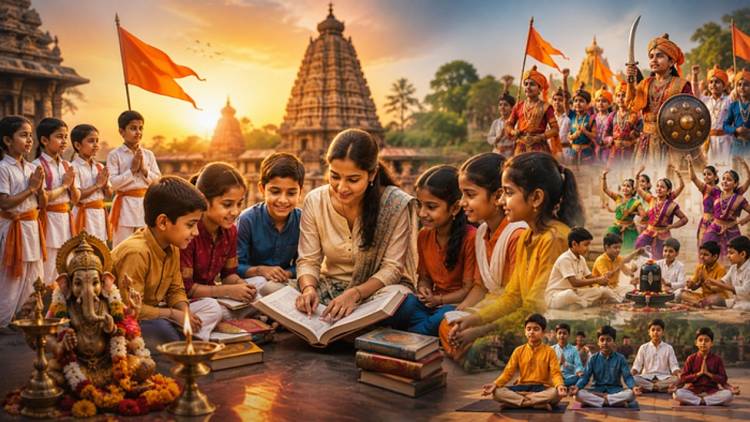
GHHF envisions village-level schools where dedicated teachers could spend several hours each week teaching children about Hindu heritage while also helping them with schoolwork and homework.
The proposed model is deliberately modest. A teacher, a few hours each week, learning materials, snacks and prasadam could create a regular space where children learn and participate together.
The idea is to make cultural education accessible without requiring elaborate infrastructure.
Because sometimes the preservation of a tradition begins with something as simple as a teacher sitting with a group of children and telling them a story.
Passing the Torch
Every generation inherits something from the one before it.
For some, that inheritance may be a language. For others, it may be music, literature, family traditions, architecture, philosophy or religious practice.
For Hindu communities, that inheritance is extraordinarily diverse — from the Vedas and Upanishads to the Bhagavad Gita, from temple traditions and festivals to yoga, devotional music, stories of saints and regional customs that have evolved across centuries.
But inheritance alone is not enough.
It must be understood.
A child who knows that Rama Navami is celebrated is learning a fact. A child who understands why the festival is celebrated, hears the stories associated with Rama, participates in a procession and discusses the values represented by those stories is developing a relationship with the tradition.
That relationship is what allows heritage to become something living rather than something merely remembered.
The Real Measure of Cultural Education
The success of a programme like Bala Samskar Kendra cannot be measured only by the number of schools or students.
Its deeper impact may become visible years later — in a young person who continues a family tradition, understands a Sanskrit verse, visits a temple with a sense of connection, teaches a younger sibling a prayer, participates in a festival with understanding, or simply recognizes that the heritage handed down to them has meaning.
That is the larger purpose of cultural education.
GHHF’s Bala Samskar Kendras are, in essence, trying to create a bridge between inheritance and identity — between what previous generations received and what the next generation will choose to carry forward.
Because monuments can preserve history, books can preserve knowledge, and temples can preserve sacred spaces.
But ultimately, it is people who keep a civilization alive.
And sometimes, preserving an ancient tradition begins with giving a child the opportunity to understand it.
Your donations are appreciated.
By Zelle: ghhfusaorg@gmail.com
PayPal: savetemples.org
By Check: GHHF, 14726 Harmony Lane, Frisco, TX 75035.
Call 601-918-7111; +91 83096 43979



 Urgent support needed for Bangladesh Hindus


