
[GHHF] Sant Tulsidas, an Avatara of Valmiki, composed the Ramacharitamanas and the Hanuman Chalisa, which remain spiritually uplifting even today.
 Tulsidas was born to Hulsi and Atmaram Shukla Dube in Rajpur, Uttar Pradesh, India, in 1532 and died on July 6, 1623. He was a Sarayuparina Brahmin by birth and an incarnation of Sage Valmiki, the author of the Sanskrit Ramayana. At the time of birth, Goswamiji was as healthy as a five-year-old boy, and instead of crying, He uttered "Ram". At that moment, Shri Ram spoke through aakaashvaani and named the divine child "Raambolaa".
From Family Man to Ascetic
Tulsidas’s wife’s name was Buddhimati (Ratnavali). Tulsidas’s son’s name was Tarak. Tulsidas was passionately attached to his wife. He could not bear even a day’s separation from her. One day his wife went to her father’s house without informing her husband. Tulsidas stealthily went to see her at his father-in-law’s house at night. This produced a sense of shame in Buddhimati. She said to Tulsidas, "My body is but a network of flesh and bones. If you would develop for Shri Rama even half the love that you have for my filthy body, you would certainly cross the ocean of Samsara and attain immortality and eternal bliss". These words pierced the heart of Tulsidas like an arrow. He did not stay there even for a moment. He abandoned home and became an ascetic. He spent fourteen years visiting various sacred pilgrimage sites.
Tulsidas’s philosophical journey into Awadi literature began after receiving blessings from Lord Shiva and Mata Parvati in a dream and an awakened state. He even mentioned this incident in Ramcharitmanas.
Throughout his lifetime, Goswami Tulsidas wrote texts and books and composed poems and songs. The biographers split the 12 works into two groups based on the language.
Incarnation of Valmiki
Tulsidas is regarded as an incarnation of the great sage Valmiki. In the Bhavishyottar Purana, Shri Shiva tells Parvati that Valmiki received a boon from Hanuman to sing the glories of Shri Ram in the vernacular during the Kali Yuga.
Nabhadas, a contemporary of Tulsidas and a great devotee, also describes Tulsidas as an incarnation of Valmiki in his work Bhaktmaal. Even the Ramnandi sect (Tulsidas belonged to this sect) firmly believes that it was Valmiki himself who incarnated as Tulsidas in the Kali Yuga.
Tulsidas used to pour the water left in his pot onto the roots of a tree that a spirit occupied. The spirit was very pleased with Tulsidas. The spirit said, "O man! Get a boon from me". Tulsidas replied, "Let me have Darshan of Shri Ram". The spirit said, "Go to the Hanuman temple. There Hanuman comes in the guise of a leper to hear the Ramayan as the first hearer and leaves the place last of all. Get hold of him. He will help you". Accordingly, Tulsidas met Hanuman and, through His grace, had Darshan, or vision, of Shri Ram.
Hanuman Chalisa was composed
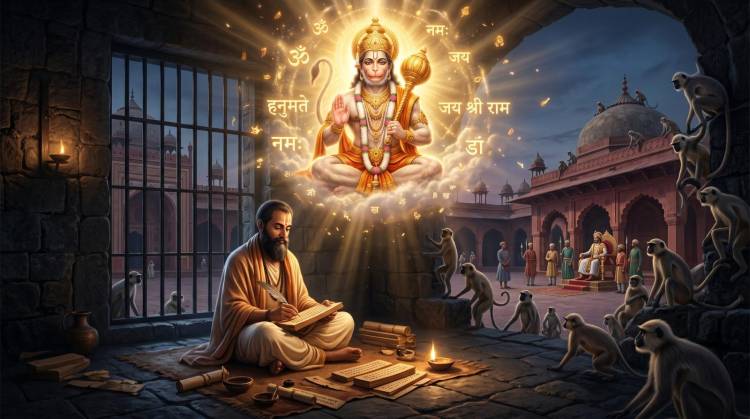
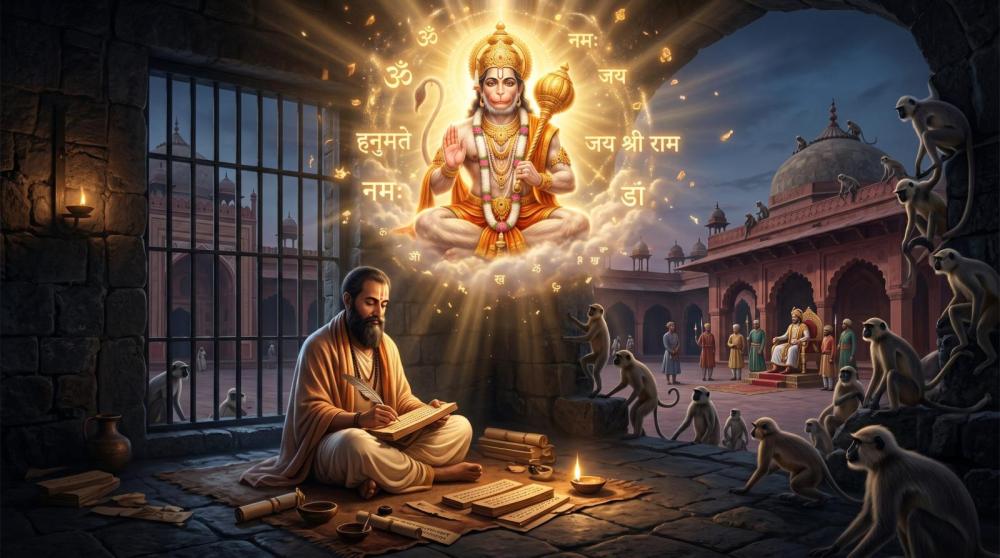
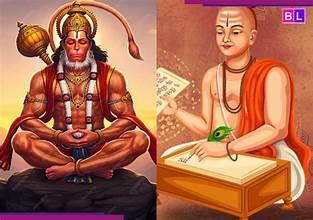
According to devotional tradition, Tulsidas composed the Hanuman Chalisa during a difficult period while imprisoned by Mughal emperor Akbar.
The story says that Tulsidas gained widespread recognition as a spiritually gifted saint. Reports of miracles and divine experiences surrounding him eventually reached Akbar’s royal court.
Akbar allegedly invited Tulsidas to demonstrate his spiritual powers. However, Tulsidas is believed to have humbly replied that he possessed no miracles himself and was merely a devotee of Lord Rama.
According to the legend, Akbar became displeased and ordered Tulsidas to be imprisoned. While in prison, Tulsidas devoted himself to prayer and chanting in praise of Lord Hanuman. During this period of intense devotion, tradition says he composed the Hanuman Chalisa.
Soon afterward, large groups of monkeys reportedly began creating chaos throughout the royal capital and palace surroundings. The disturbances became so severe that Akbar eventually released Tulsidas.
More importantly, the Hanuman Chalisa continues to endure because of what it offers people even today — courage in the face of fear, faith amid uncertainty, emotional reassurance in hardship, and spiritual calm in a fast-moving world.
Whether viewed through faith or historical curiosity, its timeless verses continue to remind people of the enduring power of devotion, resilience, humility, and inner strength.
Miracles of Tulsidas
Tulsidas lived in Ayodhya for some time. Then he shifted to Varanasi. One day a murderer came and cried, “For the love of Rama, give me alms. I am a murderer”. Tulsi called him to his house, gave him sacred food which had been offered to the Lord, and declared that the murderer was purified. The Brahmins of Varanasi reproached Tulsidas and said, “How can the sin of a murderer be absolved? How could you eat with him? If the sacred bull of Siva–Nandi–would eat from the hands of the murderer, then only we would accept that he had been purified”. Then the murderer was taken to the temple, and the bull ate from his hands. The Brahmins were put to shame.
Tulsidas once went to Brindavan. He visited a temple. He saw the image of Lord Krishna. He said, “How shall I describe Thy beauty, O Lord! But Tulsi will bow his head only when You take up bow and arrow in Your hands. The Lord revealed Himself before Tulsidas in the form of Lord Rama with bow and arrows.
Tulsidas once went to Brindavan to visit Shri Krishna's temples. Seeing the statue of Krishna, he said, "How shall I describe Thy beauty, O Shri! But Tulsi will bow his head only when You take up bow and arrow in Your hands". The Shri revealed Himself before Tulsidas in the form of Shri Ram with bow and arrows.


 Urgent support needed for Bangladesh Hindus


