
[GHHF] On the 250th Anniversary of the USA's Independence, let us also celebrate the influence of the Hindu ethos on American culture.
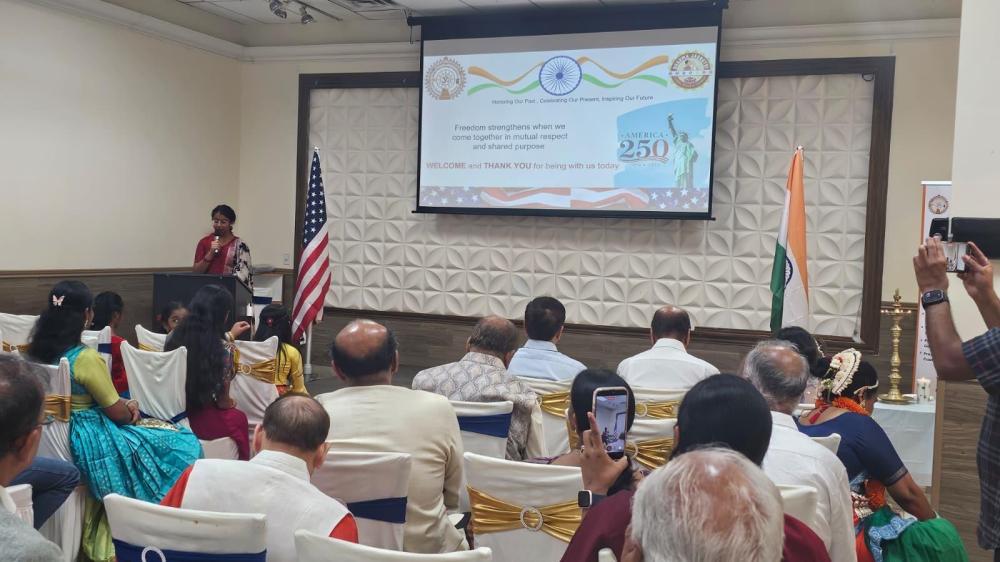
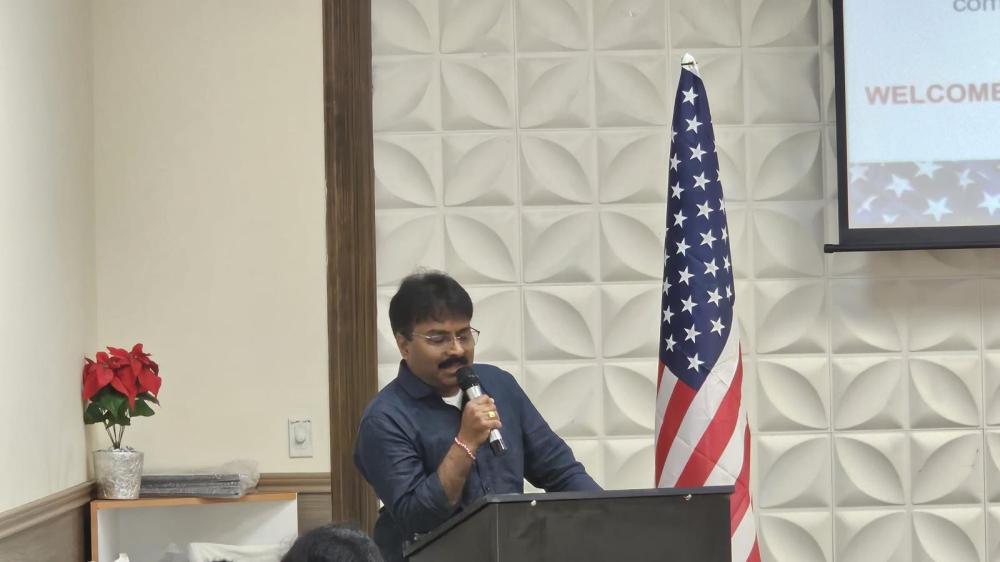
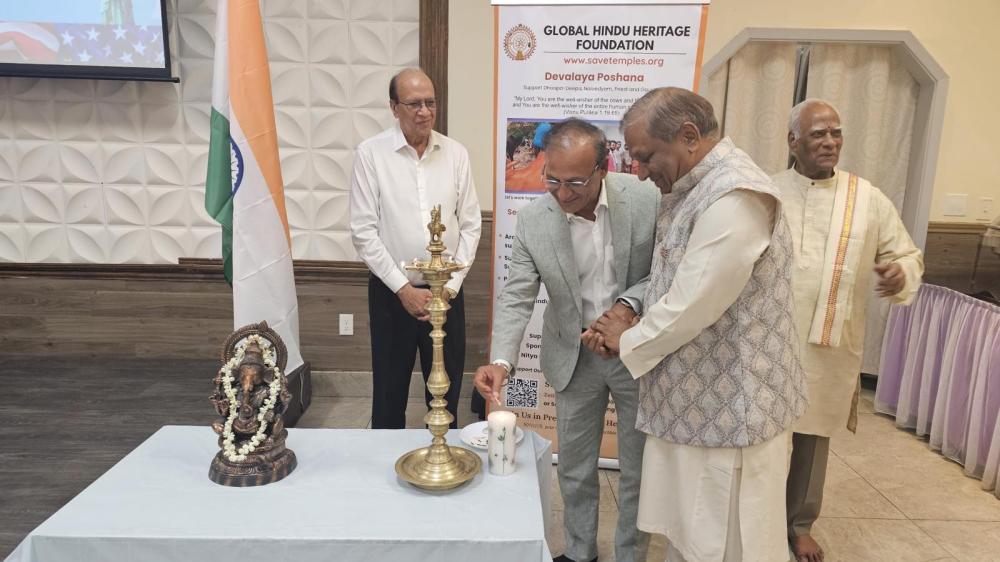
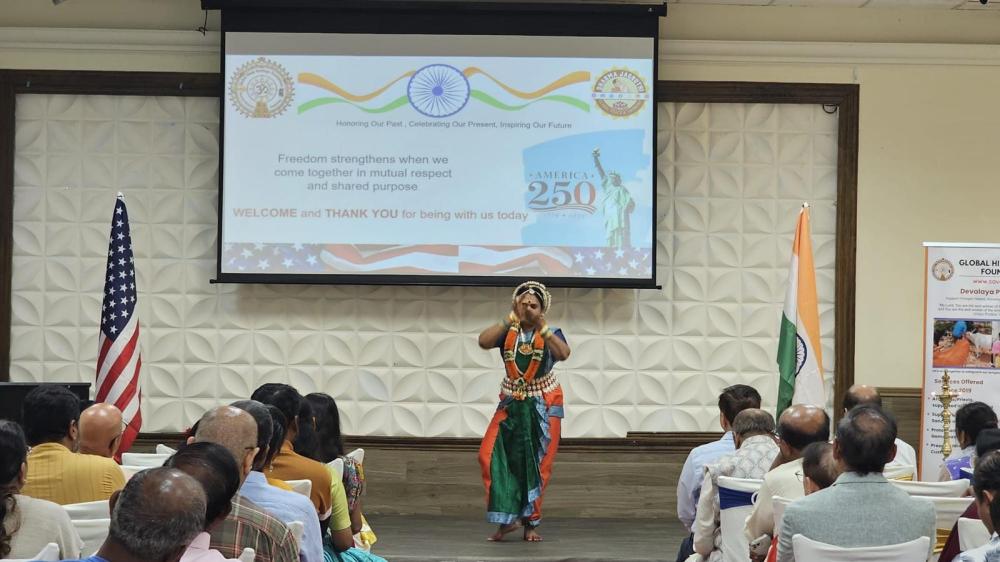
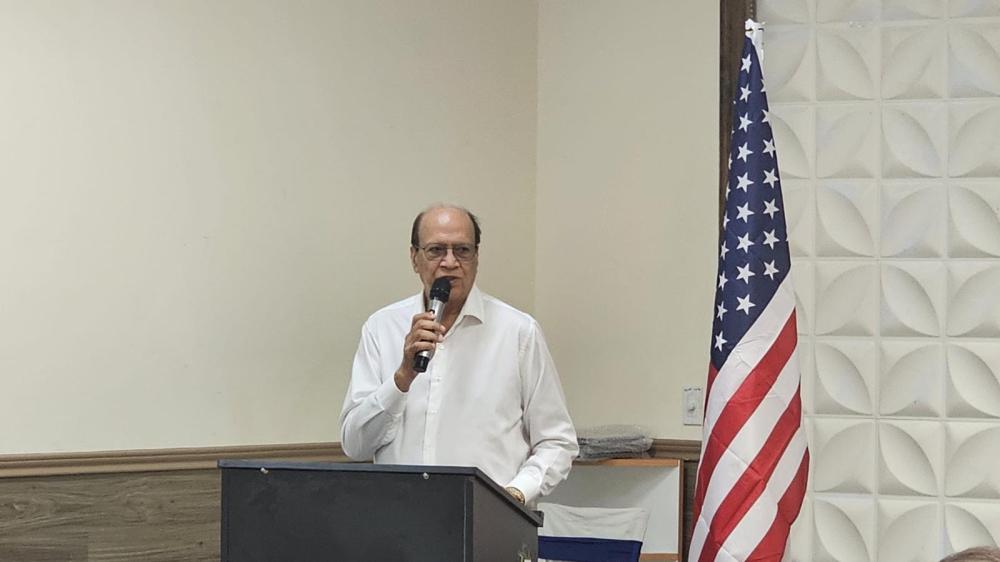
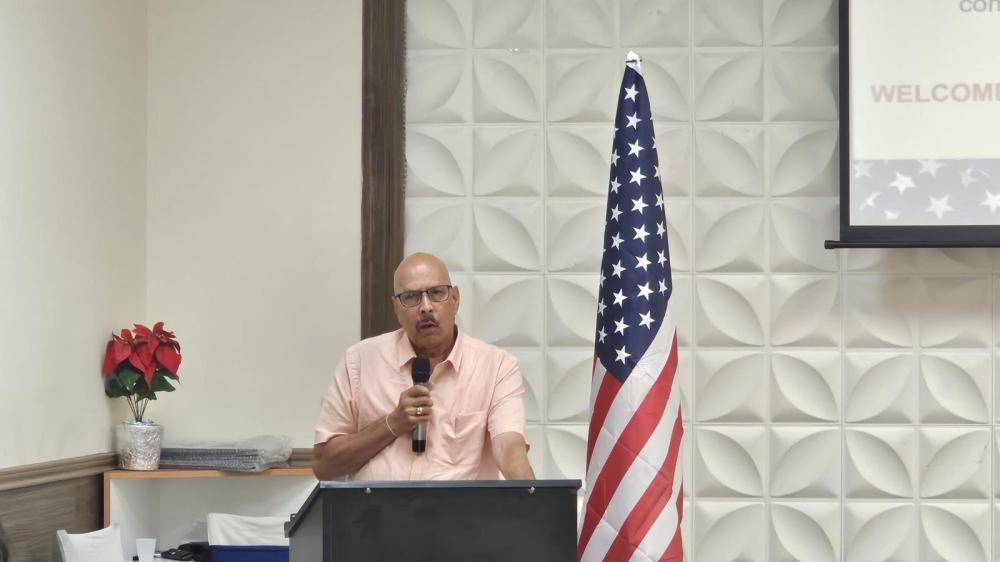
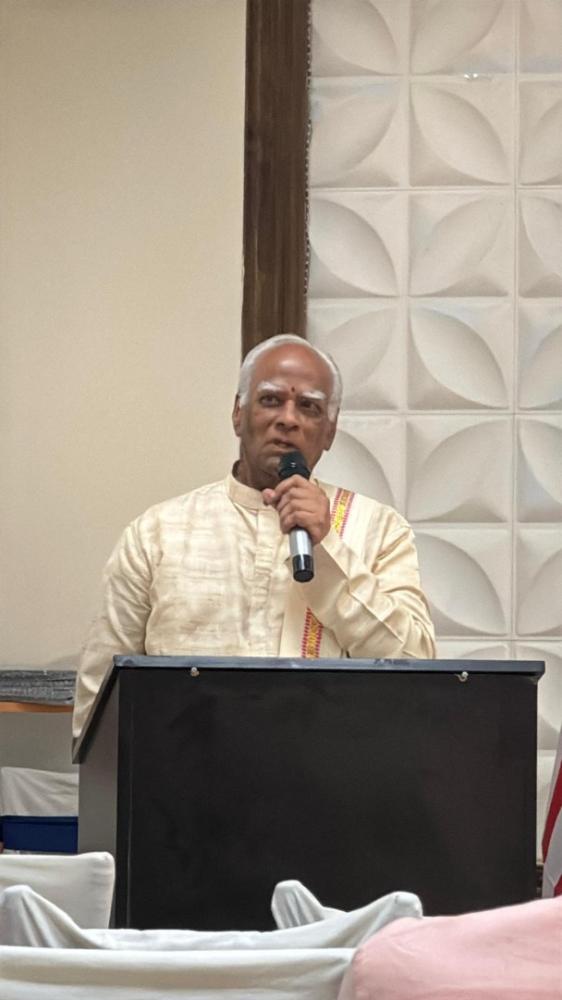
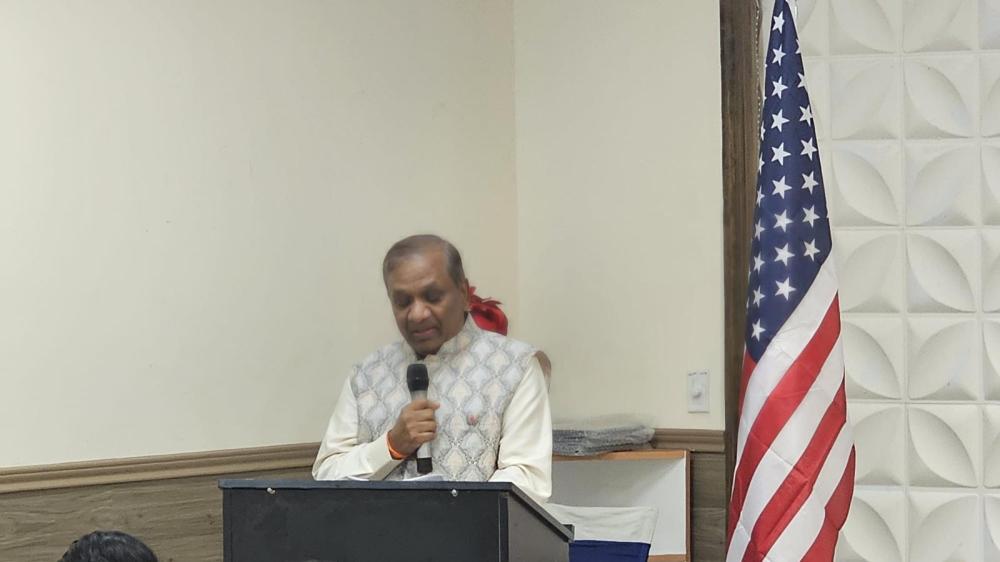
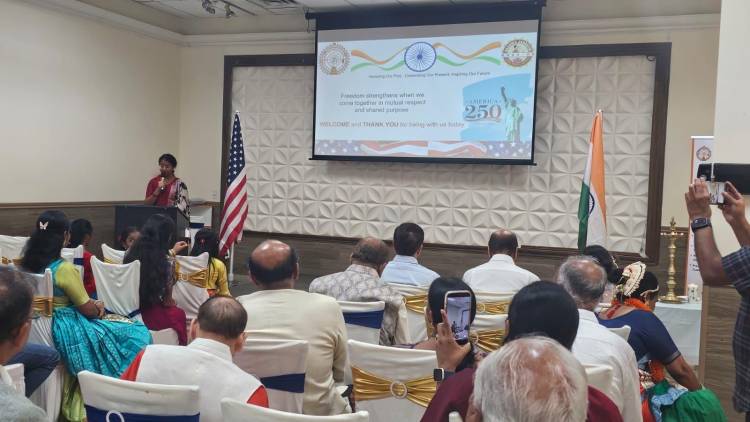 Global Hindu Heritage Foundation is extremely happy to celebrate the 250th Anniversary of the Independence of the USA on July 12, 2026, in Frisco, TX. Eight speakers spoke on the significance of the celebration. We feel blessed to celebrate the freedom of speech, the importance of separating Church and State, belief in the pursuit of life, liberty, and happiness, the Revolutionary Wars, the abolition of slavery, a land of opportunities, economic progress, technological advances, and many achievements that other countries envy. Over the last 250 years, multiple technological revolutions— digital, AI, biotech, autonomous systems, quantum, precision agriculture— are advancing rapidly, transforming every sector of the economy and national security, and fueling the rise of new industries.
Bharat has also contributed to the formation, independence, and development of the USA. Even before 1776, Indians came to the USA as servants and slaves, brought by the British East India Company in the early 1600s. The seeds of what was to become modern America were planted on May 13, 1607, when British colonists arrived at an island that they would come to call Jamestown in what is now Virginia.
The earliest documented South Asian in North America was an individual named "Tony East Indian” in 1632. He was brought to Jamestown, Virginia, on an EIC-connected vessel from London.
• The first known Indian immigrants who arrived independently in Massachusetts in 1790.
• The early 20th-century Punjabi Sikh arrivals in California's Central Valley.
• How US immigration laws shifted to allow larger waves of Indian migration in 1965.
Quaker
Hindu and Quaker philosophies share a striking number of core principles, primarily their focus on a divine essence within all people and the pursuit of peace. Quakers believe in the "Inner Light" (the presence of God within every individual). This closely mirrors the Hindu concept of Atman (the universal soul or divine essence present in all beings). Quakers practice unprogrammed, silent worship to listen for divine guidance. This strongly aligns with Hindu Dhyana (meditation) and the introspective practices found in Vedanta.
Simplicity and Equality: Both traditions highly value a simple life and radical equality. Quakers emphasize testimonies of equality and simplicity, while Hindu philosophy teaches detachment from material wealth and recognizes the same divine spark across all castes and backgrounds.
• Pacifism and Non-violence: Quakers are famously committed to peace and non-violence. This is the cornerstone of the Hindu and Yogic principle of Ahimsa (non-harming).
Transcendentalists
Hindu philosophy profoundly shaped American Transcendentalism in the 19th century. Thinkers like Ralph Waldo Emerson and Henry David Thoreau read early English translations of the Upanishads and the Bhagavad Gita, finding in them a mystical, nature-centric spirituality that served as a perfect alternative to traditional, rationalist Western religion.
The connections between these two intellectual movements are vast, with core concepts mirroring each other in distinct ways: The Over-Soul and Brahman: Emerson’s concept of the "Over-Soul"—a supreme, universal, and divine energy connecting all living things—mirrors the Hindu philosophy of Brahman, the ultimate and eternal reality.
The first deep philosophical intersections emerged through the Transcendentalist movement in the United States, which directly linked Quaker thought with ancient Hindu texts.
Ralph Waldo Emerson: Immersed himself in early English translations of the Upanishads and the Bhagavad Gita. He noticed an explicit alignment between Hindu monism (Brahman) and the Quaker concept of the Inner Light.
Rufus Jones: A foundational architect of modern Liberal Quakerism, Jones was heavily influenced by Emerson’s writings. Through Emerson's library, Jones bridged the gap between Quaker mysticism and Eastern philosophy, helping construct a 20th-century Quaker framework that viewed mystical experience as a universal phenomenon shared across global traditions.
Hindu philosophy profoundly shaped American Transcendentalism in the 19th century. Thinkers like Ralph Waldo Emerson and Henry David Thoreau read early English translations of the Upanishads and the Bhagavad Gita, finding in them a mystical, nature-centric spirituality that served as a perfect alternative to traditional, rationalist Western religion. [1, 2, 3, 4]
Henry David Thoreau
Thoreau integrated Hindu asceticism and philosophy directly into his daily lifestyle at Walden Pond, viewing himself almost as a practicing yogi.
"One sentence of the Gita is worth the State of Massachusetts many times over".
“Besides Bhagwat-Geeta, our Shakespeare seems sometimes youthfully green.”
"The reader is nowhere raised into and sustained in a bigger, purer or rarer region of thought than in the Bhagavad-Gita.
In Walden, Thoreau famously wrote, "In the morning I bathe my intellect in the stupendous and cosmogonal philosophy of the Bhagavad-Gita, in comparison with which our modern world and its literature seems puny and trivial". Later in Walden, he metaphorically connected his physical location to India's sacred river, stating that the "pure Walden water is mingled with the sacred water of the Ganges". On the Universal Light of the Vedas: Writing in his journals, Thoreau remarked that when reading the Vedas, he felt as though "some unearthly and unknown light illuminated" him, noting there is "no touch of sectarianism" in the teachings.
• On the Laws of Manu: After discovering this text in Emerson's library, Thoreau wrote, "It comes to me with such a volume of sound as if it had swept unobstructed over the plains of Hindostan... it seems to signify the laws of them all".
Walt Whitman
He was influenced by Emerson and Thoreau in his philosophical outlook on nature and life, his affinity for Vedanta, and his yogic experience. Whitman was clearly describing an experience of transcendence. He was considered a poet of mysticism, cosmic consciousness, and religion. He describes his experience as follows:
“Only in the perfect uncontamination and solitariness of individuality. . . . Only here, and on such terms, the meditation, the devout ecstasy, the soaring flight. Only here, communion with the mysteries. . .. The soul emerges, and all statements, churches, sermons, melt away like vapors. Alone, silent thought and awe, and aspiration — and then the interior consciousness, like a hitherto unseen inscription, in magic ink, beams out its wondrous lines to the sense. Bibles may convey, and priests expound, but it is exclusively for the noiseless operation of one’s isolated self to enter the pure ether of veneration, reach the divine levels, and commune with the unutterable.”
President Adams
Adams read and respected certain sacred Vedic Indian texts and noted that Rev. Joseph Priestly, the persecuted British Unitarian scientist and theologian who migrated to Pennsylvania and was a friend of Thomas Jefferson, used them, too, and was sympathetic to Hinduism. Writing to Jefferson, Adams said, “Where is to be found theology more orthodox, or philosophy more profound, than in the introduction to the [Hindu] Shasta. ‘God is one creator of all universal sphere, without beginning, without end. God governs all the creation by a general providence, resulting from his eternal designs. Search not the essence and the nature of the eternal, who is one; your research will be vain and presumptuous. It is enough that day by day, and night by night, you adore his power, his wisdom and his goodness, in his works.”’ That certainly is a form of mysticism.
“We find that materialists and immaterialists existed in India and that they accused each other of atheism, before Berkeley or Priestley, or Dupuis, or Plato, or Pythagoras were born. Indeed, Newton himself appears to have discovered nothing that was not known to the ancient Indians. He has only furnished more ample demonstrations of the doctrine they taught.”
‘God is one, creator of all, Universal Sphere, without beginning, without End. God governs all the Creation by a general Providence, resulting from his eternal designs. Search not the Essence and the nature of the Eternal, who is one; your research will be vain and presumptuous. It is enough that, day by day, and night by night, you adore his Power, his Wisdom and his Goodness, in his Works. The Eternal willed, in the fullness of time, to communicate of his Essence and of his Splendor, to Beings capable of perceiving it. They as yet existed not. The Eternal willed, and they were. He created Birma, Vitsnow, and Sib.’ These Doctrines, Sublime if ever there were any Sublime, Pythagoras learned in India and taught them to Zaleucus and his other disciples.”
Hindu Gurus in America
Swami Vivekananda ignited the spiritual compass in the USA, where he declared that Sectarianism, bigotry, and its horrible descendant, fanaticism, have long possessed this beautiful earth. They have filled the earth with violence, drenched it often and often with human blood, destroyed civilization and sent whole nations to despair. Had it not been for these horrible demons, human society would be far more advanced than it is now.
Sri Paramahamsa Yogananda, Maharshi Maha Yogi, Sri Ganapathy Sachchidananda Swamiji, Sri Prabhupada, Sri Dayananda Saraswati, Sri Chinmayananda, and many gurus over the last five decades have changed the spiritual climate in the USA. Newsweek magazine published an article titled “We are all Hindus now.”
More than 1,000 Hindu temples contribute to cultural diversity, with an emphasis on self-development.
More than 20 percent are practicing yoga and meditation. About 33 percent believe in reincarnation. As many as 80 percent of people in the USA believe in karma theory.
Now you will find more than 30 companies in the USA are run by Indians. They are recognized across economic circles in the USA for their management.
USA has given unprecedented opportunities to Hindus. We proudly celebrate the 250th Anniversary of the independence of the USA.
Your donations are appreciated;
By Zelle: ghhfusaorg@gmail.com
PayPal: savetemples.org
By Check: GHHF, 14726 Harmony Lane, Frisco, TX 75035.
By Rupees: call 601-918-7111; +91 83096 43979




 Urgent support needed for Bangladesh Hindus


