
[DJF & GHHF] 1st Day of Ramayana Leadership Workshop with a lecture on Sanatana Dharma, Bhajan singing, and Yoga Practice.
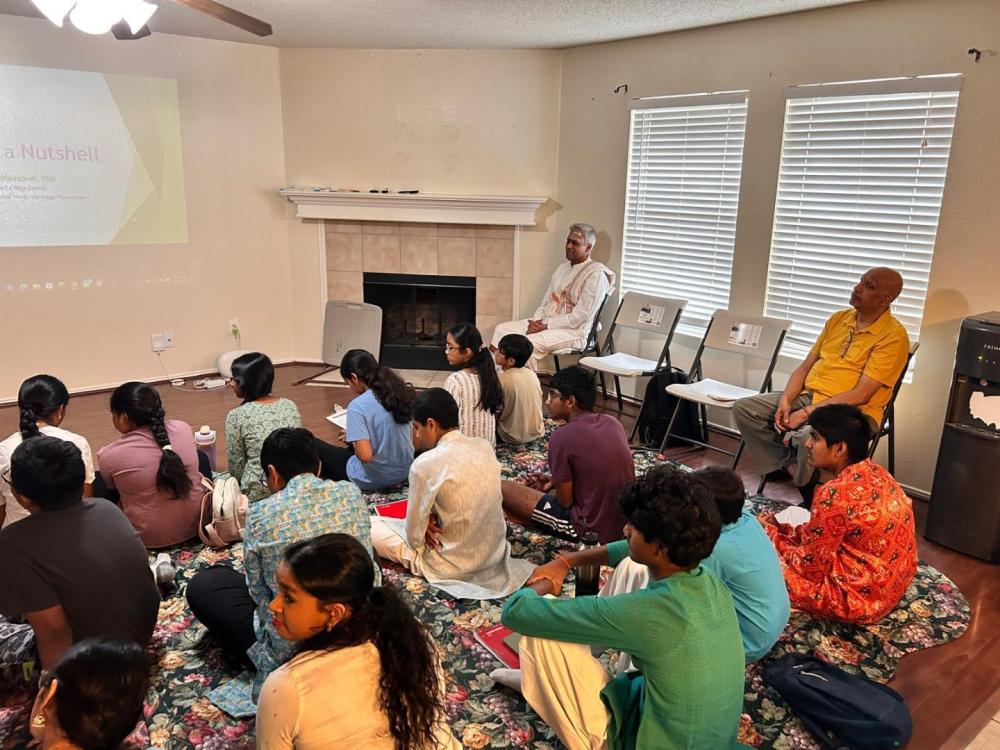
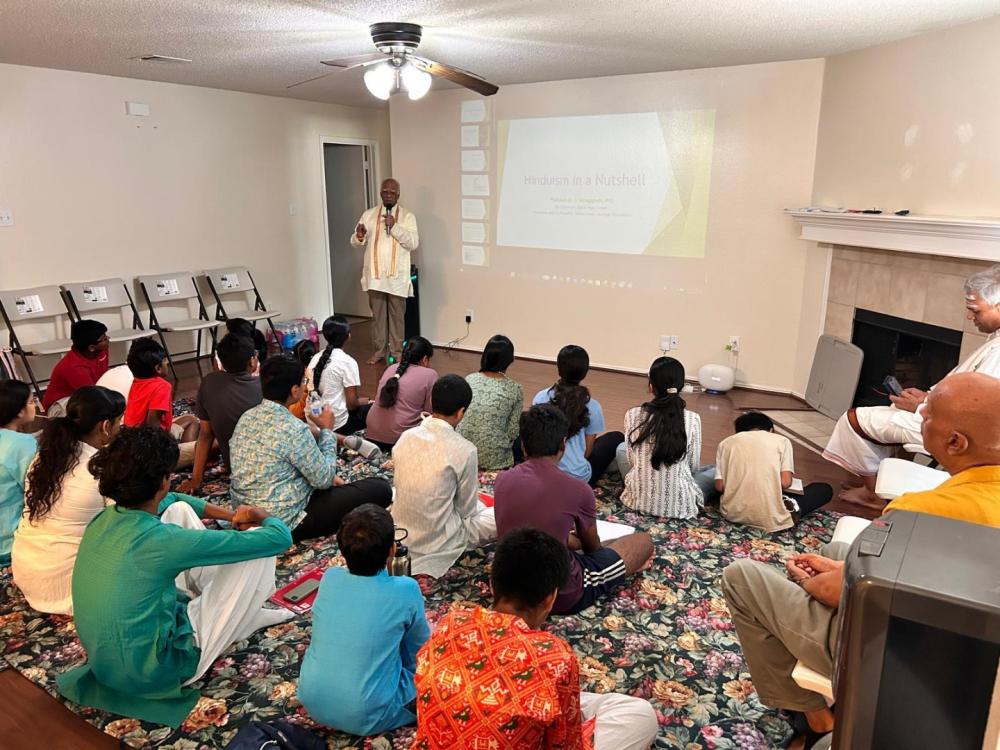
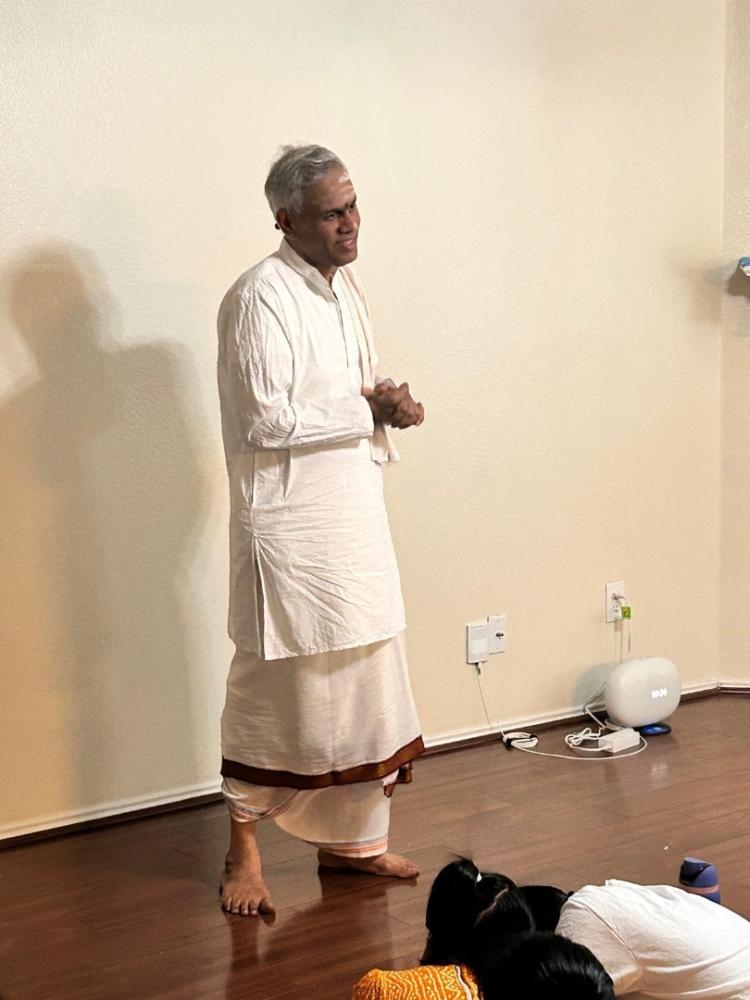
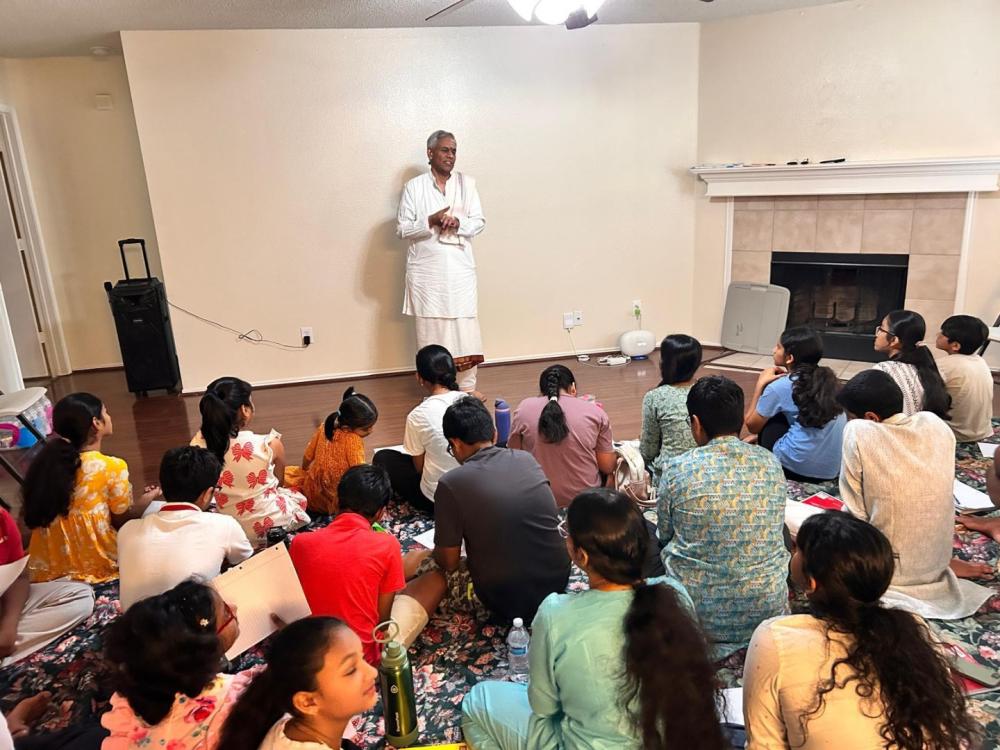
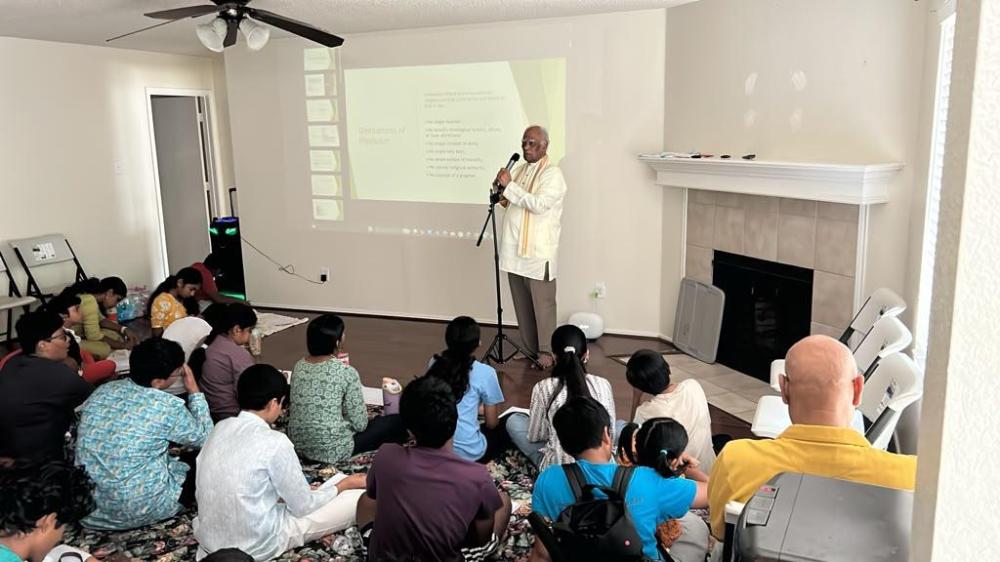
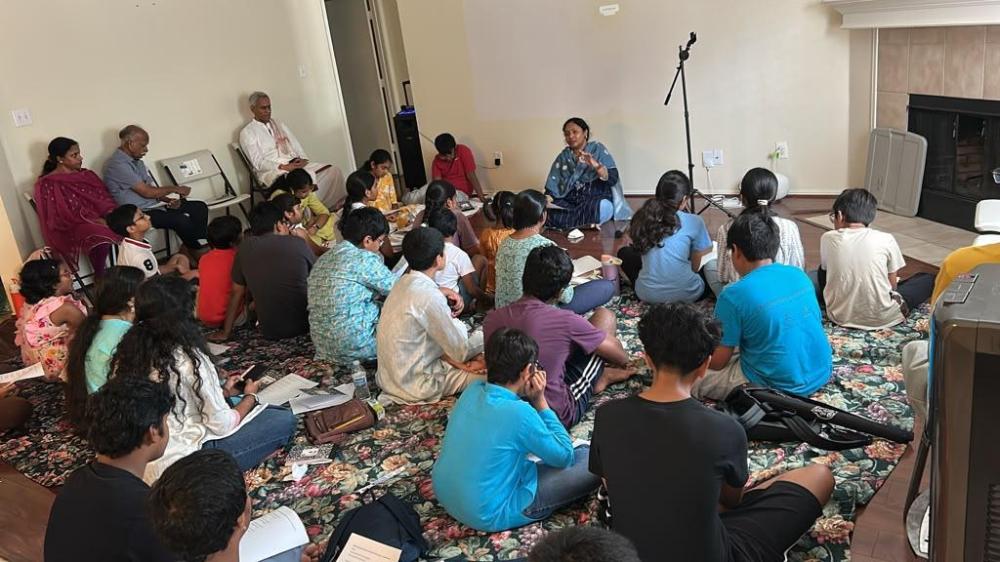
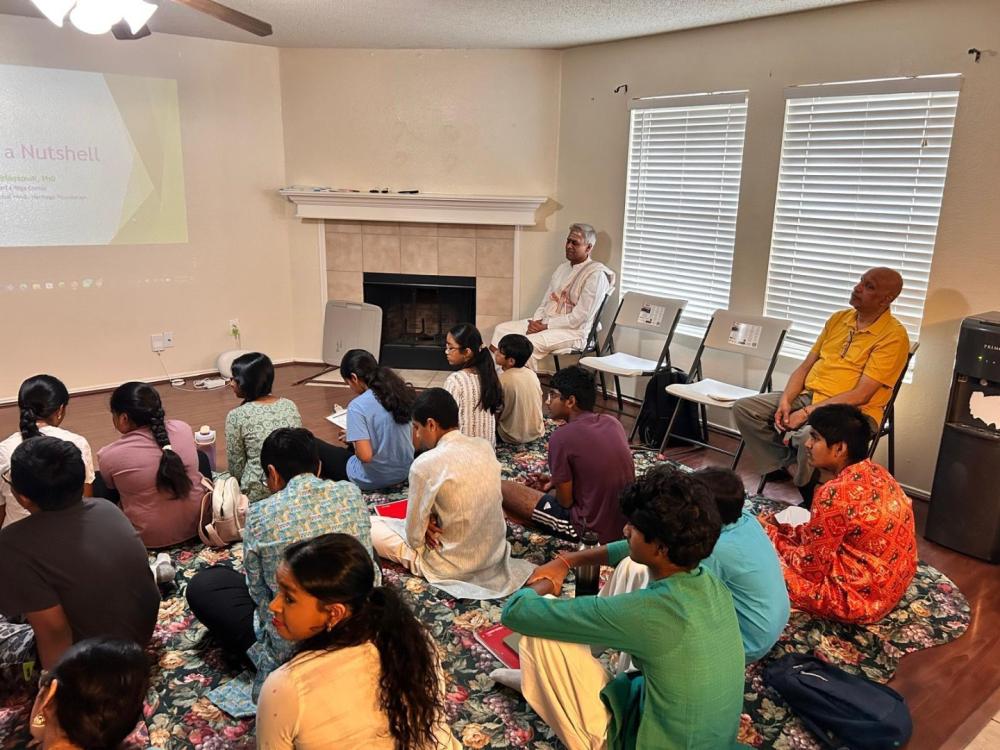
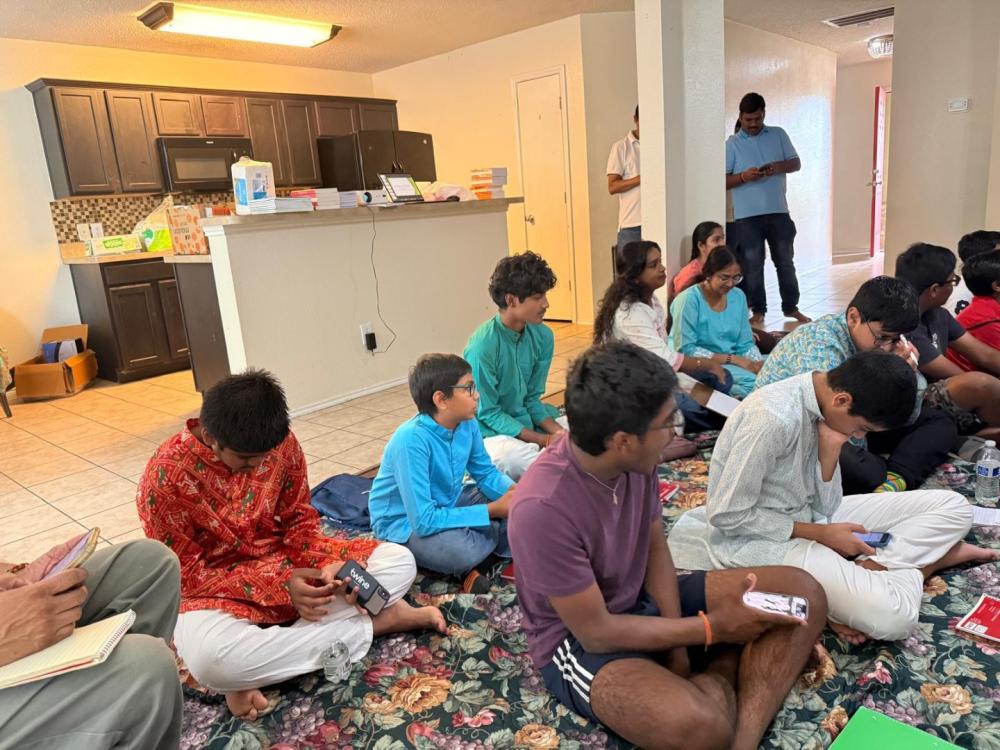
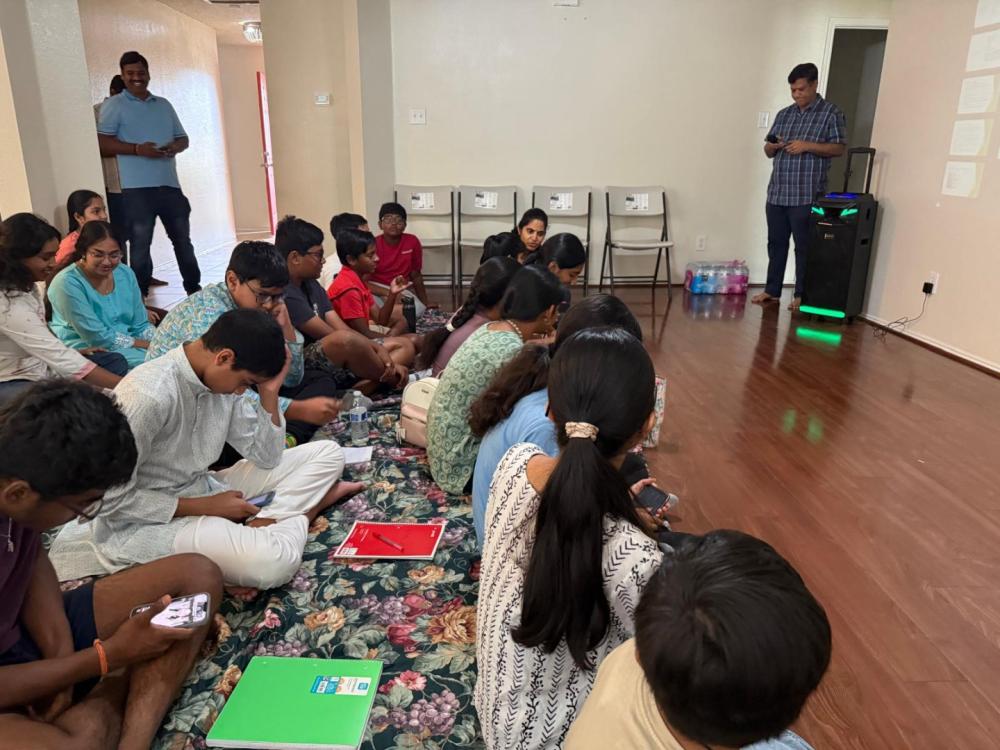
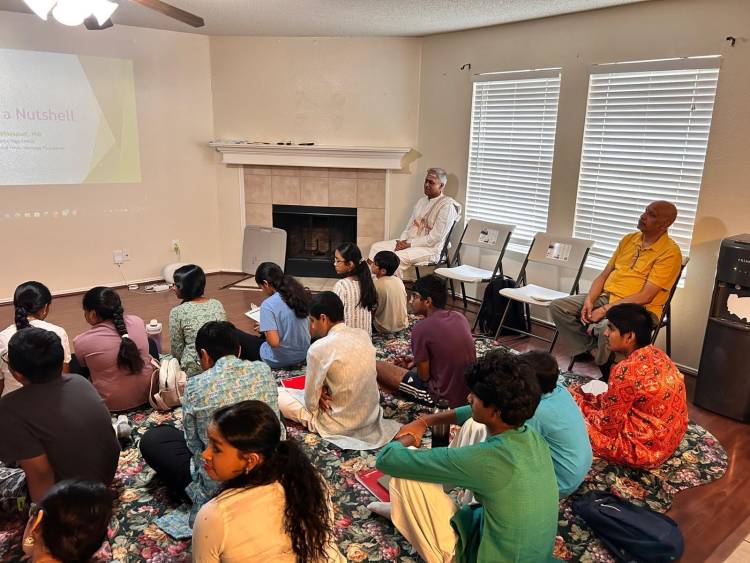 Dharma Jagruti Foundation and Global Hindu Heritage Foundation are conducting the Ramayana Leadership Workshop for our youth in Frisco, Texas, over three days, July 17 through July 19. About 34 youth are enrolled in the workshop. On the first day, Sri Sairam Poguluru discussed several incidents from the Ramayana and how advanced their technology was. Prakasarao Velagapudi talked about Sanatana dharma and how it is different from other religions, and its scientific uniqueness. Ranjitha Nanganuri led the bhajan singing.
We summarize the presentations of Sri Sai Poguluru below:
The Vālmīki Rāmāyaṇa, composed by Ādikavi Vālmīki Maharishi, is one of the greatest epics of Sanātana Dharma. It consists of approximately 24,000 ślokas, organized into 500 sargas (chapters) across seven kāṇḍas: Bāla Kāṇḍa, Ayodhyā Kāṇḍa, Araṇya Kāṇḍa, Kiṣkindhā Kāṇḍa, Sundara Kāṇḍa, Yuddha Kāṇḍa, and Uttara Kāṇḍa. More than the life story of Lord Rāma, the Rāmāyaṇa is a timeless guide to righteous living (Dharma), leadership, family values, and social responsibility.
The epic begins with an important dialogue between Vālmīki Maharishi and Devarṣi Nārada. Vālmīki asks whether anyone in the world embodies the sixteen noble qualities, including truthfulness, courage, compassion, gratitude, self-control, wisdom, and unwavering commitment to Dharma. Nārada replies that such an ideal person is indeed rare (bahavo durlabhāś caiva), but identifies Lord Rāma as the perfect embodiment of these virtues. This dialogue establishes the purpose of the Rāmāyaṇa—to present an ideal model of human character.
The opening chapter of the Bāla Kāṇḍa is the celebrated Saṃkṣepa Rāmāyaṇa, a concise summary of the entire epic. In approximately 100 ślokas, with nearly 80 verses narrating the complete storyline, it demonstrates one of the earliest and finest examples of structured summarization, showing how complex knowledge can be presented clearly and appropriately according to the audience and context.
After receiving Nārada's teachings and the sacred Rāma narrative, Vālmīki entered deep meditation and, by the grace of Goddess Sarasvatī, was blessed with a divine vision of the events of the Rāmāyaṇa—past, present, and future. He then composed the epic and entrusted its preservation and dissemination to Lava and Kuśa, whom he trained in his āśrama as the first exponents of the Rāmāyaṇa.
The Bāla Kāṇḍa also presents profound lessons on governance and society. The description of Ayodhyā illustrates exemplary city planning, architecture, prosperity, and civic administration. The Amātya Varṇanam describes the noble qualities expected of ministers, emphasizing integrity, competence, and accountability. Likewise, the Rāja Varṇanam outlines the qualities of an ideal ruler, highlighting disciplined living, balanced habits, and ethical leadership. These principles resonate with the teaching of the Bhagavad Gītā (6.17): "Yuktāhāra-vihārasya…", which emphasizes moderation in food, recreation, work, sleep, and daily life as the foundation for physical, mental, and spiritual well-being.
King Daśaratha, wishing to continue his righteous legacy beyond his lifetime, performed the Putrakāmeṣṭi Yajña for worthy progeny. This discussion also introduced the concept of Sapta Santānam—seven enduring forms of noble legacy, including providing drinking water, protecting forests and animals, supporting education, and other charitable works that benefit society across generations. Following the yajña, Lord Rāma, Bharata, Lakṣmaṇa, and Śatrughna were born and raised with exemplary virtues.
After completing their education, Sage Viśvāmitra sought Rāma's assistance in protecting his yajña from disruptive forces. During this journey, Rāma confronted Tāṭakā, illustrating that Dharma requires protecting innocent people from harmful and destructive behavior, irrespective of the wrongdoer's status or gender. Rāma then accompanied Viśvāmitra to Mithilā, where he broke Lord Śiva's mighty bow, won the hand of Sītā Devī in marriage, and returned to Ayodhyā, marking the conclusion of the Bāla Kāṇḍa and preparing the stage for the events of the Ayodhyā Kāṇḍa.
The Bāla Kāṇḍa teaches that true greatness lies in character, disciplined living, righteous leadership, lifelong learning, and unwavering commitment to the welfare of all beings. These timeless principles continue to inspire individuals, families, and societies seeking to live in accordance with the ideals of Sanātana Dharma.
Sanatana Dharma
Prakasarao Velagapudi stated in his presentation that Sanatana Dharma has evolved over 5000 years. It is replete with the Vedas, Upanishads, Puranas, Mahabharata, Ramayana, and many other scriptures that cover a variety of social, spiritual, scientific, and philosophical topics. Indian Supreme Court defined Hindus as one who accepts and reveres the Vedas, exhibit a spirit of tolerance, believe in the four cosmic periods of creation and destruction, believe in reincarnation, believe in polytheism, and others.
Hinduism differs from monotheistic religions (such as Christianity and Islam) in that it has: No single founder, no specific theological system (Study of gods' attributes), no single concept of deity, no single holy text, no single system of morality, no central religious authority, and no concept of a prophet.
Hinduism is a way of life. It tells us how to conduct ourselves in line with ethics, morals, principles, and character. “There is only one God, but endless are his aspects and endless are his names”
Scientifically, its contribution is unparalleled – zero, infinity, value of pi, Decimal system, Concept of gravity, anatomy, astronomy, mathematics, algebra, trigonometry, Calculus, quantum physics, gravity, theory of the atom, Heliocentric theory, plastic surgery, cataract surgery, dentistry, pregnancy, human anatomy, metallurgy, etc.
Hinduism is never afraid of science. Hindus believe that science will prove their theories. Science & Hinduism never collide. Pi – 4th by Aryabhata accurately calculated: 3.141592653
The Bhagavad Purana states that the Earth has existed for over 4.32 billion years. How do we know whether it is true or false? Professor Carl Sagan and his associates conducted research and concluded that they found no discrepancy between their findings and what the Bhagavat Purana says.
Our ancestors knew about airplanes long before anyone could imagine them. Vimana (Airplane): “One that goes from country to country, continent to continent, and planet to planet through the sky is called Vimana.” Maharshi Vishwambar.
Several Nobel laureates lauded the depth of knowledge in Hindu scriptures and always sought their wisdom, science, and spirituality to advance their own research. Whether in Physics, mathematics, science, surgery, or literature, they always looked toward Hindu scriptures for their guidance and inspiration. Some of the Nobel laureates who have given credit to Hindu scriptures include Niels Bohr, Erwin Schrödinger, Werner Heisenberg, Brian David Josephson, George Wald, Albert Einstein, Max Planck, T S. Eliot, Herman Hesse, Rabindranath Tagore, V S Naipaul; Nelson Mandela; Martin Luther King, Desmond Tutu, Albert Schweitzer, Thomas Huxley, Yoshinori Ohsumi, Count Maurice Maeterlinck.
The day of activities concluded with singing bhajans led by Rangita Nanganuri.
Your donations are appreciated;
By Zelle: ghhfusaorg@gmail.com
PayPal: savetemples.org
By Check: GHHF, 14726 Harmony Lane, Frisco, TX 75035.
By Rupees: call 601-918-7111; +91 83096 43979



 Urgent support needed for Bangladesh Hindus


