
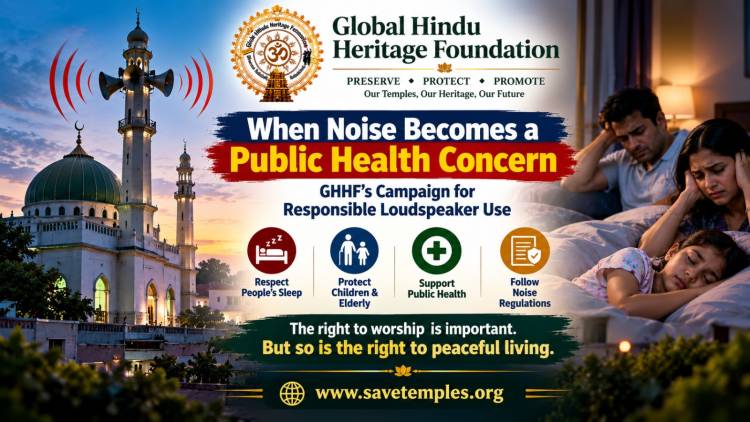
[GHHF] When Noise Becomes a Public Health Concern: GHHF’s Campaign for Responsible Loudspeaker Use
 https://vahids.medium.com/when-noise-becomes-a-public-health-concern-ghhfs-campaign-for-responsible-loudspeaker-use-02c690217652
Vahid S
Noise pollution is often treated as a minor inconvenience, but for people living in densely populated residential areas, prolonged or excessive sound can become a serious disturbance to everyday life. Early-morning loudspeakers, repeated announcements and amplified religious programmes can be particularly difficult for people who work late shifts, children, senior citizens and those who need uninterrupted rest.
The Global Hindu Heritage Foundation (GHHF) has been raising concerns about excessive loudspeaker use since 2021, calling for regulations governing amplified sound to be enforced consistently across religious and community institutions.
The Growing Concern Over Loudspeakers
One issue specifically highlighted by GHHF is the use of loudspeakers at mosques for Azaan, particularly during early-morning hours. GHHF has argued that residents should not have their sleep and daily routines disrupted by excessive amplified sound when they are within their homes.
This can be particularly challenging for people who work late-night or night-shift jobs. Someone returning home after working through the night may depend on those morning hours for sleep. Children, elderly residents and families with young children can also be affected by repeated high-volume sound.
The concern, however, is broader than any one religious community. Temples, mosques, churches and other institutions using loudspeakers should all follow the applicable noise regulations. The issue is not the right to worship, but the excessive amplification of religious activities in residential neighbourhoods.
What Does the Law Say?
India’s Noise Pollution (Regulation and Control) Rules, 2000 establish different ambient noise standards depending on the character of an area. For residential areas, the prescribed limit is 55 dB(A) during the daytime and 45 dB(A) at night. Daytime is defined as 6 a.m. to 10 p.m., while nighttime runs from 10 p.m. to 6 a.m.
The rules also regulate the use of loudspeakers and public-address systems. Their use generally requires written permission from the designated authority, while their use during nighttime hours is subject to restrictions and specified exceptions.
The underlying principle is simple: religious expression and public activities must operate within the framework of laws designed to protect the wider community.
GHHF’s Efforts in Andhra Pradesh
According to GHHF’s account, the organization began actively pursuing complaints about excessive loudspeaker use in 2021. One case involved residents of Nakka Rameswaram village in East Godavari district, who complained about high-volume loudspeakers being used by a church.
After repeated complaints to local authorities, the matter was eventually taken up by the police. GHHF says that the pastor was asked to provide an undertaking that loudspeakers would not be used in a manner that disturbed residents.
Raising the Issue in Assam
GHHF also raised concerns in Assam in 2022 regarding loudspeaker use for Azaan at mosques during nighttime and early-morning hours.
The organization’s Assam representatives submitted a memorandum to the district administration and Pollution Control Board, seeking enforcement of existing noise regulations. GHHF says that following discussions with the administration, mosque committees were instructed to avoid loudspeaker use for Azaan during the restricted nighttime and early-morning periods.
For GHHF, this represented an example of how administrative intervention can address residents’ concerns without preventing religious communities from continuing their regular practices.
A Question of Equal Enforcement
The larger issue is not whether a particular community should be allowed to pray. It is whether the same noise regulations should apply equally to everyone.
A mosque should be able to conduct Azaan, just as a temple can conduct prayers and a church can conduct services. At the same time, amplified sound should remain within the limits prescribed by law so that surrounding residents can sleep, study, work and carry on with their daily lives.
This is especially important in residential areas where homes, schools, hospitals and places of worship exist close to one another.
Protecting the Right to Peace and Rest
For someone who works late into the night, an early-morning loudspeaker can mean losing the only available hours for sleep. For students, elderly people, young children or people who are unwell, persistent noise can similarly affect their wellbeing and quality of life.
GHHF’s campaign therefore frames loudspeaker regulation as a civic and public-health concern rather than simply a religious dispute.
The goal should be a reasonable balance: religious practices can continue, but excessive amplified noise should not come at the expense of another person’s right to peaceful living.
Ultimately, the principle is straightforward: religious freedom should be respected, and noise regulations should be respected as well — consistently, fairly and without discrimination.
Donations are appreciated.
By Zelle: ghhfusaorg@gmail.com
PayPal: savetemples.org
By Check: GHHF, 14726 Harmony Lane, Frisco, TX 75035.
By Rupees: call 601-918-7111; +91 83096 43979


 Urgent support needed for Bangladesh Hindus


