
[GHHF] Celebration of Devi Navaratri – Students learned about the nine forms of Goddess Parvati, Vijayadashami, and the fall of three demons – Part 2
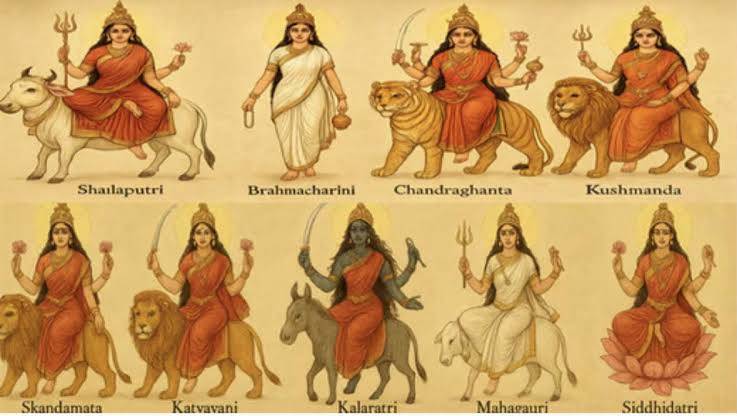 Nine Forms of Goddess Parvati
Prathamam Shailaputree Cha Dviteeyam Brahmachaarinee |
Triteeyam Chandraghanteti Kooshmaandeti Chaturthakam ||
Panchamam Skandamaateti Shashtham Kaatyaayaneeti Cha |
Saptamam Kaalaraatri Cha Mahaagauriti Cha Ashtamam ||
Navamam Siddhidaatri Cha Navadurgaah Prakeertitaah ||
The first day is dedicated to Shailaputri. Shailaputri is the form in which Goddess Parvati incarnated as the daughter of Himavan. Her form embodies the steadfastness and courage of a mountain. Meditating upon her inspires us to remain unwavering in our goals when faced with life's hardships.
The second day is dedicated to Brahmacharini. This form reflects the severe penance Goddess Parvati undertook to attain Lord Shiva. Her unwavering resolve—persisting despite all obstacles—teaches us the value of determination. Whether a student is lagging in their studies or a task proves difficult to master, one must continue the effort without giving up.
The third day is dedicated to Chandraghanta. She is the form who bears a bell-shaped moon on her forehead. Her appearance embodies a blend of both peace and valor. This form reminds us to maintain inner tranquility while standing courageously for righteousness when the need arises.
The fourth day is dedicated to Kushmanda. She is worshipped as the embodiment of the creative force. Creation is far greater than destruction. Nurturing a noble thought, planting a sapling, sharing knowledge, or performing a service that benefits society—all these are manifestations of the creative power.
On the fifth day, we worship Skandamata—the form of the Mother holding Kumaraswamy in her lap. Motherhood signifies not only love but also values, courage, and a sense of duty; the form of Skandamata reminds us of a mother's responsibility to guide her child along the right path.
The sixth day is dedicated to Katyayani. We worship Goddess Katyayani as a heroic force ready to uphold Dharma (righteousness). This form embodies the courage to stand up for righteousness without retreating in fear when faced with injustice.
The seventh day is dedicated to Kalaratri. She embodies a fierce form; we worship her as the power that destroys darkness, fear, and evil forces. Kalaratri reminds us to confront the fear within us and find the courage to stand up for the truth.
The eighth day is dedicated to Mahagauri. We worship her as a symbol of purity and serenity. Just as it is essential to keep the body clean, it is equally important to keep the mind pure. We must cleanse our minds by shedding jealousy, hatred, dishonesty, and bad habits.
The ninth day is dedicated to Siddhidatri, the Goddess who bestows Siddhis (spiritual attainments or powers). True fulfillment in life is not merely about wealth or success; a personality becomes complete only when knowledge, humility, a spirit of service, a good nature, and courage come together.
Thus, by worshipping the nine forms of the Goddess over these nine days, we too can cultivate nine positive qualities within ourselves.
Vijayadashami — The Victory Achieved by Dharma
Vijayadashami falls on the tenth day following the nine days of Navaratri worship. A primary spiritual significance of this auspicious day is the victory achieved by the Divine Mother over Mahishasura. Similarly, the victory of Sri Rama over Ravana is also associated with Vijayadashami.
Rama was the Prince of Ayodhya. To honor the promise made by his father, he left the kingdom and went into exile in the forest. Sita and Lakshmana accompanied him. While they were in the forest, Ravana abducted Sita and took her to Lanka. To bring Sita back, Rama befriended Sugriva. Hanuman dedicated himself to Rama's service, and the Vanara army marched alongside Rama. After crossing the ocean and reaching Lanka, Rama waged war against Ravana. Ravana was a man of great wisdom and a scholar of the Vedas; he was also a devotee of Lord Shiva. He possessed immense strength and royal power. However, an arrogance that surpassed his wisdom grew within him. He committed an act of unrighteousness (adharma) by abducting Sita—another man's wife—against her will. Ultimately, Rama slew Ravana. Ravana's wisdom did not save him; neither did his strength nor his kingdom. His life demonstrated that when one abandons righteousness, even power cannot save a person.
Another tradition associated with Vijayadashami is the worship of the Shami tree. During the era of the Mahabharata, the Pandavas concealed their weapons in a Shami tree while living incognito. After completing this period of exile, Arjuna retrieved the weapons and prepared for a righteous war. Commemorating this event, there is a tradition in many regions of worshipping the Shami tree on Vijayadashami.
An undeniable truth proclaimed by three episodes: No force that insulted a woman has survived.
A deep examination of these three episodes reveals a clear, profound truth: the root cause of unrighteousness and the downfall of mighty empires lies in disrespecting women—viewing them as weak and inferior, or violating their dignity.
● The Fall of Mahishasura: When seeking a boon from Lord Brahma, Mahishasura ensured he would not meet his death at the hands of any male—whether god, demon, or human. However, he dismissed women as weak beings incapable of harming someone as mighty as himself. It was this very underestimation that led to his total annihilation at the hands of Goddess Durga, the embodiment of supreme divine power.
● The Destruction of Ravanasura: Ravana was invincible—having commanded the celestial planets—a devout worshipper of Shiva, and a master of the four Vedas. Yet, he abducted Mother Sita—another man's wife—against her will and violated her dignity. That act of dishonoring a woman reduced the golden city of Lanka to ashes and completely wiped out Ravana's lineage.
● The Destruction of Kurukshetra and the Pandavas' Victory: Where did the seeds of the Mahabharata war—which culminated in the Pandavas' victory on the day of Vijayadashami—originate? The foundation for the fall of the Kaurava empire was laid the moment Draupadi was subjected to the indignity of having her garments forcibly removed in the royal court. The tears shed by that woman—humiliated and mocked as helpless—ultimately reduced the Kaurava clan to ashes on the battlefield of Kurukshetra.
Mere possession of power does not make anyone invincible; it is only when that power is coupled with humility and righteousness that it commands universal reverence. Wherever women were belittled as weak or their dignity was violated—be it by the mighty or by Vedic scholars—they inevitably vanished into oblivion, leaving no trace behind.
We must conquer the Mahishasura within us.
We must conquer the Ravana within us.
We must conquer the demonic tendencies within us.
We should cultivate courage while worshipping the Divine Mother's power.
We should uphold truth while remembering the righteousness of Rama.
We should pass on our culture to future generations while respecting our traditions.
We should use our strength not just for ourselves, but for the benefit of society.
Then, Vijayadashami will not remain merely a festival.
It will transform into a victory we have achieved over the evil within ourselves.
That is the true Vijayadashami.
Your donations are appreciated.
By Zelle: ghhfusaorg@gmail.com
PayPal: savetemples.org
By Check: GHHF, 14726 Harmony Lane, Frisco, TX 75035.
By Rupees: call 601-918-7111; +91 83096 43979


 Urgent support needed for Bangladesh Hindus


