
[GHHF] Bhagavad Gita, Vedanta, and Yoga are not Religious; they are moral sciences, says Tamil Nadu High Court Judgment
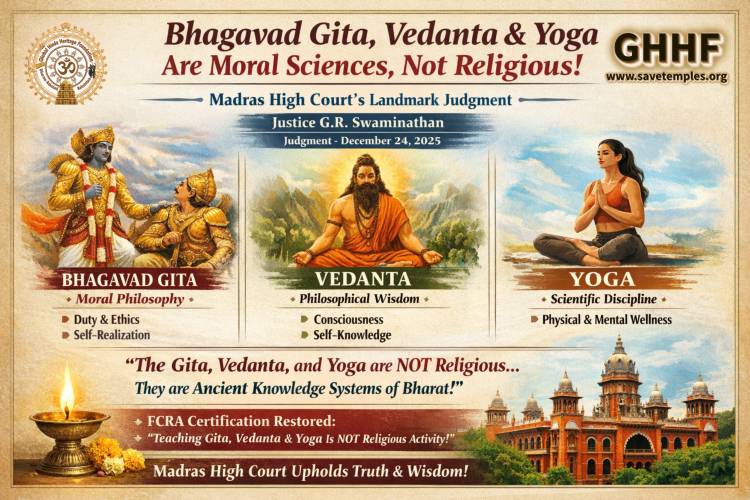 The Madras High Court issued a landmark judgment on the nature of the Bhagavad Gita, Vedanta, and Yoga. The Court was emphatic in its judgment that these subjects are not religious and are moral sciences. Global Hindu Heritage Foundations appreciates and congratulates Arsha Vidya Parampara Trust and His Holiness Swami Sarwananda Saraswati for their yeoman service in helping thousands of organizations that have been denied their NCRA certification due to a preconceived notion that their subjects are religious.
Established in 2017, the Arsha Vidya Parampara Trust first applied for FCRA registration in 2021, but the request has faced multiple delays over the past few years. The Home Ministry had sought additional clarifications and eventually rejected a fresh application filed in January 2025. The Centre said the organization appeared to be “religious” in nature and claimed it had received foreign funds without prior permission.
Justice G.R. Swaminathan of the Madras High Court ruled on December 24, 2025, that teaching or promoting the Bhagavad Gita, Vedanta, and Yoga does not constitute “religious activity” under Indian law and therefore cannot be used as a ground to deny or cancel foreign funding under the FCRA (Foreign Contribution Regulation Act).
What is the case?
The Arsha Vidya Parampara Trust first applied for FCRA registration in 2021, but the request has faced multiple delays over the past few years. The Home Ministry had sought additional clarifications and eventually rejected a fresh application filed in January 2025. The Centre said the organization appeared to be “religious” in nature and claimed it had received foreign funds without prior permission.
What is FCRA, and who is qualified to get certification?
FCRA certification, under the Foreign Contribution Regulation Act (India), is required to legally receive foreign funds. It allows NGOs, societies, trusts, and Section 8 companies in India to receive foreign funds for social, educational, or cultural activities. It requires registration, at least 3 years of existence, and the maintenance of audited financial records.
‘It is moral science.’
“The petitioner is also engaged in imparting the message set out in the Bhagavad Gita, the authority concluded that the petitioner is a religious body. The Bhagavad Gita is not a religious book. It is rather a moral science. What applies to the Bhagavad Gita would apply to Vedanta. It represents the pure philosophy evolved by our ancestors. As regards Yoga, it would be atrocious to view it through the prism of religion. It is something universal,” the court said.
The Court observed:
“The Bhagavad Gita is not a religious book. It is a treatise on moral philosophy. It cannot be confined to any particular religion and forms an integral part of Bharatiya civilisation.”
The judgment insists that if the authority wants to reject on the ground that an organisation is religious, it must be categorical and must base that conclusion on relevant materials—not on vibes, not on discomfort, and certainly not on the mere presence of the words “Gita”, “Upanishads” or “Yoga” in a trust deed.
The Court held that “appears to be religious” is not a finding; that compounding cannot be used as a backdoor disqualification without fair warning; and that the Gita, Vedanta, and Yoga, especially when taught as moral philosophy and universal practice, cannot be mechanically boxed into “religion” for FCRA purposes. The ruling resets the evidentiary threshold for denial, while also raising hard questions about how the State should regulate genuinely religious activity without criminalizing India’s civilizational knowledge systems.
The Court made three crucial legal distinctions:
1) BHAGAVAD GITA
The Court held that the Gita is primarily a work of moral philosophy and ethical guidance, not a sectarian religious text. It teaches:
• Duty (dharma)
• Self-discipline
• Self-realization
• Ethical action
Therefore, teaching the Gita is education in moral science, not religious preaching.
2) VEDANTA
Vedanta was classified as a philosophical system concerned with:
• Consciousness
• Reality
• Self-knowledge
It is comparable to Western philosophy, not to religious rituals or worship.
3) YOGA
Yoga was held to be a civilizational and scientific discipline, dealing with:
• Physical health
• Mental discipline
• Psychological well-being
It is not religious instruction.
CONSTITUTIONAL SIGNIFICANCE
The judgment reaffirmed that:
• India’s civilization predates modern religions
• Its philosophical traditions are part of national culture, not sectarian faith
• The State must not misclassify Indian knowledge systems as “religion” to suppress them
In brief, the Madras High Court held that Gita, Vedanta, and Yoga are civilizational systems of knowledge—not religious preaching—and therefore cannot be restricted under India’s FCRA.


 Urgent support needed for Bangladesh Hindus


