
[GHHF] Alain Danielou’s “love for Mother India, defies all expression.” His glorification of Hinduism was exceptional.
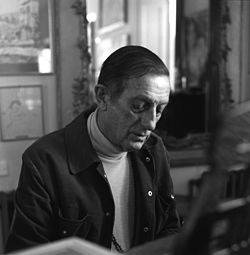 Alain Danielou, known as Shiv Sharan (October 4, 1907- January 27, 1994), was a son of French aristocracy, author of 30 books on philosophy, religion, history, and arts of India, including Virtue, Success, Pleasure, & Liberation: The Four Aims of Life in the Tradition of Ancient India. And Hindu Polytheism. He was perhaps the first European to boldly proclaim his Hinduness. He settled in India for fifteen years to study Sanskrit. In Benaras, Danielou came in close contact with Karpatriji Maharaj, who inducted him into the Shaivite school of Hinduism, and he was renamed Shiv Sharan.
After he completed Kama Sutra, at 85, he began translating Artha Shastra, which he would never be able to finish."
After leaving Benaras, he also served as the director of Sanskrit manuscripts at the Adyar Library in Chennai for some time.
Greatly interested in the symbolism of Hindu architecture and sculpture, he made a thorough study of it and took long trips with Raymond Burnier to Khajuraho, Bhubaneswar, and Konarak, as well as to many lesser-known sites in Central India and Rajputana.
In 1949, Sharan was appointed professor at the Hindu University of Benaras and director of the College of Indian Music.
In 1954, he left Benaras to take up the post of director of the Adyar Library of Sanskrit manuscripts and editions at Madras.
Danielou said, "The Hindu lives in eternity. He is profoundly aware of the relativity of space and time and of the illusory nature of the apparent world."
Hinduism is a religion without dogmas. Since its origin, Hindu society has been built on rational bases by sages who sought to comprehend man's nature and role in creation as a whole. (source: Virtue, Success, Pleasure, & Liberation: The Four Aims of Life in the Tradition of Ancient India p. 9 and 154).
Whatever value we attribute to more recent religions, we should not attempt to equate Hinduism with them. Hinduism cannot be opposed to any creed, to any prophet, to any incarnation, to any way of realization, since one of its fundamental principles is to acknowledge them all and many more to come.
"Hinduism, especially in its oldest, Shivite form, never destroyed its past. It is the sum of human experience from the earliest times. Non-dogmatic, it allows everyone to find their own way."
In the recent supplement to his memoirs, he wrote, “The only value I never question is that of the teachings I received from Shaivite Hinduism, which rejects any kind of dogmatism, since I have found no other form of thought which goes so far, so clearly, which such depth and intelligence, in comprehending the divine and the world’s structures”.
"I believe any sensible man is unknowingly a Hindu and that the only hope for man lies in the abolition of the erratic, dogmatic, unphilosophical creeds people today call religions."
"He had adopted Indian thinking in a very deep way and without any reservations. He felt that its philosophy and religion had no rival anywhere in the world as to its profundity and logic. He regarded all other systems as completely wrong.
Overwhelmingly convinced of the importance of culture and religion as presented by Hinduism, Alain Daniélou always considered himself a Hindu and, in his last interview, declared, "India is my true home".
Sharan could never cope with the Anglicized Indians who were ruling the country on Western concepts. He intensely disliked Gandhi and, to some extent, Tagore. "I soon discovered," he wrote, "that I had nothing to learn from English-speaking Indians--not even from such well-known philosophers as Vivekananda, Radhakrishnan, Aurobindo or Bhagwan Das."
"Men like Nehru and Tagore knew nothing about Hindu culture except through British authors," he observed. "Tagore was very much opposed to the rigors of the traditional society."
He would never speak about himself. He did say that just after his initiation, he felt things had changed, and he was now completely included in the Hindu world. He did puja nearly every day, but refused to allow anyone to watch.
Returned Europe
But after India's independence, when the new government attacked orthodoxy, it was suggested that his role would be more useful in the West, where he could present the true face of Hinduism.
On returning to Europe," Sharan went on with characteristic bluntness, "I was amazed at the childishness of theological concepts, and at the barrenness of what is called religion." I found a rudderless humanity, clutching the dying tree of Christianity, without even understanding why it was dying."
Sharan, though he left India in the early sixties, never to return, remained a Hindu throughout his life. He wrote in The Way to the Labyrinth, "I have never gone back to India. I know that the world I lived in will always exist, but has simply retreated into its shell, waiting for the storms of the modern age to clear away. In order to find it again, I should have to go through the new Europeanized India that is so alien to me. It would take me a long while to readjust to its customs and rites, to that way of life, eating, and dressing, without which there is no possible access to the traditional world. There would be nothing new for me to find, nothing I did not already know in the former existence I was granted by the Gods in that kingdom beyond time and space--the wondrous and eternal land of India."
He had kept his Indian habits, that is to say, ways of doing things, and especially a way of reflecting--the constant questioning of all established concepts. He had a sense of values of good and evil that made him different from anyone else around him.
"A few years later, in the 1960s, he got in the habit of wearing a rudraksha mala, a very Saivite thing, and what surprised everyone most was a little golden Linga that he would wear in a very obvious way over his Scottish neckties.
Testimonials
In 1987, famed sitarist Ravi Shankar, whom Sharan introduced to Europe in 1958, wrote of him, "Having covered the entire length and breadth of our great heritage during his long span, so deep were his feelings for the Motherland that he embraced Hinduism and took the name of 'Shiv Sharan.' Thus began the incessant flow of his glorious writings on Indian culture, especially covering music, philosophy, and religion. To this day, his continuous contribution to promoting India's cultural heritage abroad through his works has no parallel in modern history. His unflinching devotion to our culture and, above all, love for Mother India, defy all expression."
Famed violinist Yehudi Menuhin said in 1981, "It was Daniélou who, more than anyone else, thanks to his gifts of enthusiasm, ardor, and communication skills, has furnished many elements of mutual comprehension which brought us closer to one another. The fact that music is today recognized as an essential value of all cultures and a universal discipline is to a large degree thanks to Daniélou." Mrs. Gobeil, director of Arts and Cultural Life at UNESCO, observes, "Daniélou was conscious of the value of traditional cultures 50 years before we were."


 Urgent support needed for Bangladesh Hindus


