



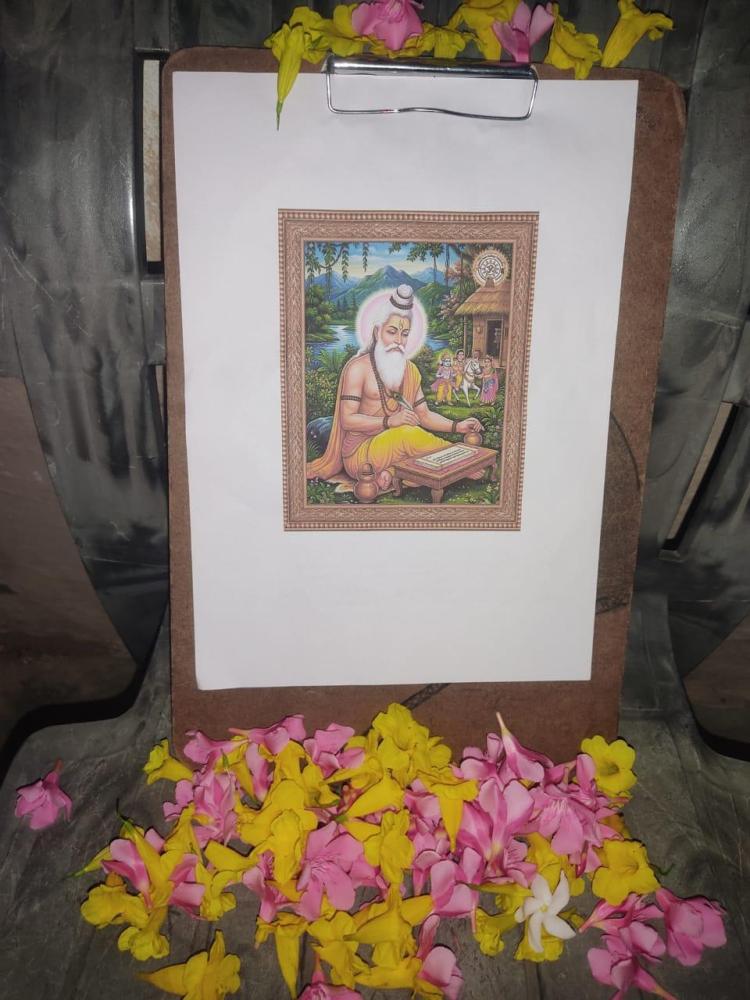
[GHHF] Maharshi Valmiki Jayanti: A symbol of transformation, compassion, spiritual practice, and wisdom.
Honoring Maharshi Valmiki
Celebrating Maharshi Valmiki’s birth on Ashwayuja Shukla Purnima – October 25.
On Ashwayuja Shukla Purnima, we honor Maharshi Valmiki, the Adi Kavi (first poet), who gave the world the Ramayana and the ideals of Sri Rama and Dharma. His life is also a timeless lesson in transformation, discipline, compassion, and sharing wisdom with future generations.
From Ratnakara to Valmiki
Before becoming a sage, Valmiki was Ratnakara, a forest robber who believed his actions were justified because he was supporting his family. His life changed when he encountered Sage Narada.
Narada asked whether Ratnakara’s family would share the consequences of the sins he committed. When Ratnakara questioned them, they replied that supporting them was his duty, but the consequences of his actions were his alone.
This truth shook Ratnakara. Accepting responsibility, he returned to Narada and asked how he could change. Narada guided him to chant “Sri Rama,” and Ratnakara left his former life to undertake intense penance.
Years passed while he remained absorbed in spiritual practice. Ants built an anthill around him, yet his concentration did not waver. When he emerged, he was transformed and became known as Valmiki, from the Sanskrit word valmika, meaning anthill.
His transformation teaches that the past does not permanently define a person. Through awareness, resolve, disciplined effort, and guidance, anyone can acknowledge mistakes and choose a better path.
Valmiki’s life therefore offers children a message of hope: sincere change is possible when reflection is followed by steady practice.
Compassion and the First Shloka
Later, while walking to the Tamasa River with his disciple Bharadwaja, Valmiki saw a joyful pair of Krauncha birds. A hunter killed the male, and the female cried out in anguish. Deeply moved by the suffering of the small bird, Valmiki spontaneously uttered a shloka:
His grief became poetry, showing how compassion can turn pain into art and wisdom.
“Maa Nishaada Pratishthaam Tvamagamah Shaashvateeh Samaah |
Yat Krauncha Mithunaadekam Avadheeh Kaama Mohitam ||”
This first poetic verse established Valmiki as the Adi Kavi. The episode teaches that compassion should extend beyond human beings to animals, birds, and nature. A heart touched by the suffering of a voiceless creature inspired a magnificent epic.
The Ideal of Sri Rama
Before composing the Ramayana, Valmiki asked Narada whether anyone in the world fully embodied sixteen noble qualities, including virtue, courage, truthfulness, gratitude, self-control, wisdom, compassion, exemplary conduct, and commitment to righteousness.
Narada answered that Sri Rama possessed all these qualities. Inspired to show the world how an ideal person lives and practices Dharma, Valmiki resolved to compose Sri Rama’s life as the Ramayana.
The Ramayana contains 24,000 verses and is traditionally associated with the “Gayatri Ramayana,” which links the syllables of the Gayatri Mantra to every thousand verses. More than a story, the epic teaches respect for parents, fidelity to one’s word, fraternal love, friendship, sacrifice, truth, courage, Dharma, and the duties of a ruler.
Passing Wisdom to Future Generations
Valmiki also ensured that this wisdom reached future generations. In his ashram, Lava and Kusha learned, understood, memorized, and recited the epic melodiously. Their dedication reminds children that true learning is not rote repetition alone; it requires understanding, regular practice, correct expression, and heartfelt engagement.
Valmiki’s journey brings these lessons together. Ratnakara recognized his wrongdoing, accepted Narada’s guidance, and transformed himself through penance. Compassion gave rise to the first poetic verse; the search for an ideal human being inspired the Ramayana; and teaching Lava and Kusha carried its wisdom forward.
A Lasting Message for Everyone
Valmiki Jayanti is therefore more than a commemoration. It invites each of us to resolve: “I can change, learn something good each day, admit and correct my mistakes, meet difficult tasks with focus, feel the suffering of others, and share what I learn.”
The transformation from Ratnakara to Valmiki reveals a lasting truth: our past need not determine our final identity. Through wise choices, disciplined effort, knowledge, and compassion, every person can elevate life toward goodness and greatness.
Your donations are appreciated.
By Zelle: ghhfusaorg@gmail.com
PayPal: savetemples.org
By Check: GHHF, 14726 Harmony Lane, Frisco, TX 75035.
By Rupees: call 601-918-7111; +91 83096 43979
{{album_1678}}






 Urgent support needed for Bangladesh Hindus


